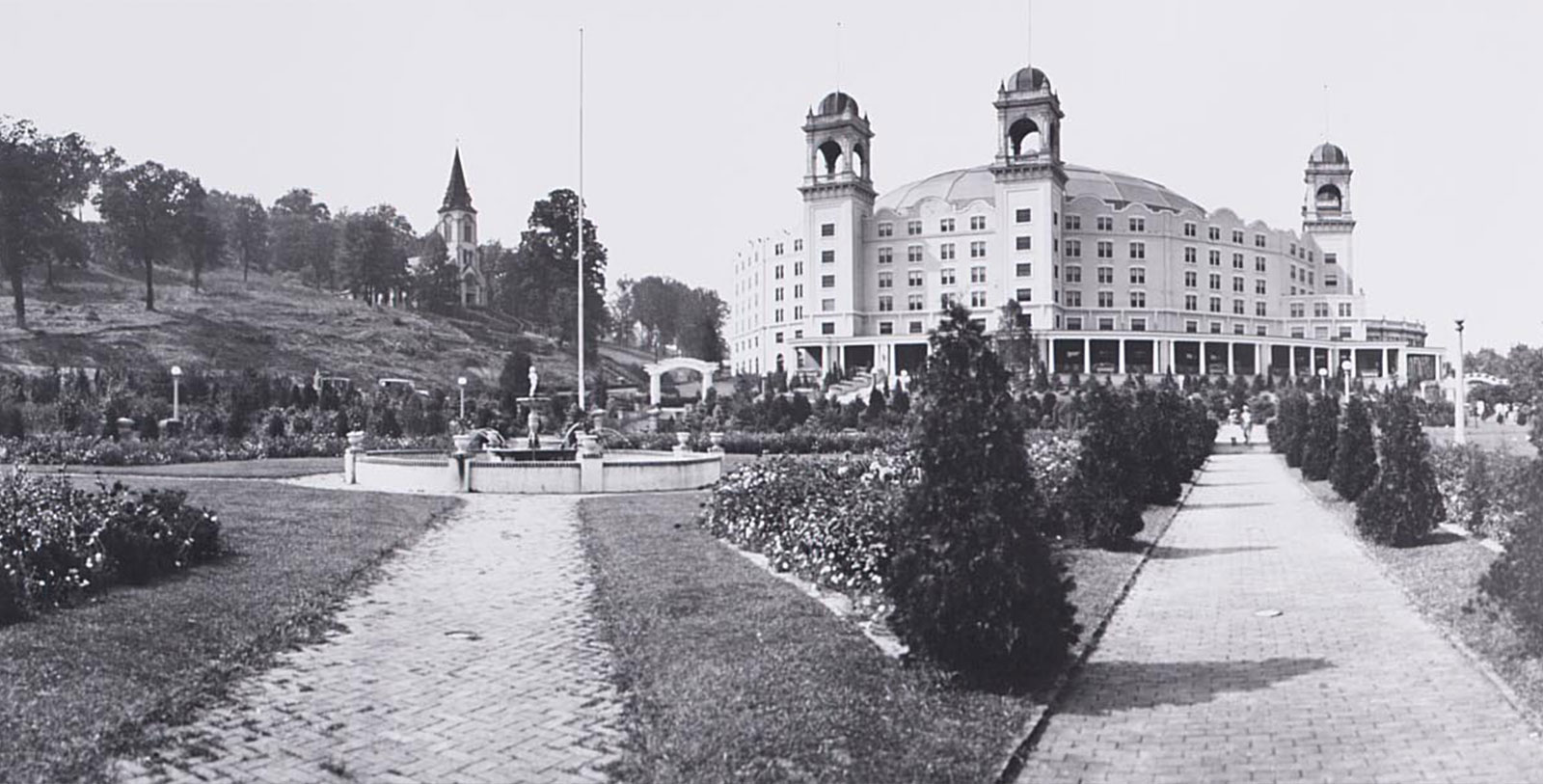
West Baden Springs Hotel
History
Discover West Baden Springs Hotel, which is affectionately considered by many as the Eighth Wonder of the World.
A member of Historic Hotels of America since 2015, the West Baden Springs Hotel has stood as an iconic landmark in Indiana for the better part of three centuries. Its story traces all the way back to the mid-19th century, when an enterprising physician named John A. Lane managed to acquire some 770 acres of land just outside of the Township of French Lick. The acreage had originally belonged to William a Bowles—another physician who had just constructed a brilliant holiday destination called the French Lick Springs Hotel in 1845. But Bowles barely had time to operate his beautiful new resort, for he volunteered to serve in the Mexican-American War a year later. To ensure that the business remained prosperous in his absence, Bowles leased the retreat to Lane for five years. The deal stipulated that Lane would earn a cut of the revenue as well as a large tract of undeveloped land, should he make the French Lick Springs Hotel profitable. When Bowles finally resumed control over the resort at the beginning of the 1850s, he was thoroughly impressed that Lane had stayed true to their agreement. Dr. Bowles then allowed Lane to purchase land from anywhere that he owned. As such, Lane decided to obtain a marshy area known as “Mile Lick” just one mile away from the French Lick Springs Hotel. Confused, Bowles allowed the transfer, for the area routinely flooded. But Lane had envisioned the space as a suitable location for another holiday destination, as it contained its own hidden mineral spring. After clearing the land with the help of a sawmill he financed, he began constructing his very own resort hotel. Lane debuted his new venue as the “Mile Lick Inn” a year later, marking the beginning of an intense rivalry between the two locations that was to last for decades.
By 1855, a small settlement had emerged near the Mile Lick Inn that quickly developed a reputation as a resort community due to the presence of both Lane’s business and the nearby French Lick Springs Hotel. As such, the residents decided to name their village “West Baden” in reference to a similar spa town in Germany called “Wiesbaden.” Lane, in turn, rechristened the Mile Lick Inn as the “West Baden Springs Hotel.” He would continue to act as the main proprietor of the location for the next 28 years, although he allowed other hoteliers to manage it on his behalf. Among the individuals to whom Lane leased the West Baden Springs Hotel were Robert and Josephine Warren, as well as Hugh and Mary Wilkins. But in 1883, Lane eventually sold the destination to a group of investors led by Amos and John Stout. Merchants from Paoli, Indiana, were more interested in the business around West Baden than the resort itself. Nevertheless, the Stouts and their colleagues spent thousands of dollars improving the West Baden Springs Hotel, expanding the site exponentially. Their decision to renovate the location could not have come at a better time. In 1887, a wave of new tourist traffic arrived in the area when the Chicago, Indianapolis, and Louisville Railway established an extension of its line (called the Monon Railroad) to both the French Lick Springs Hotel and the West Baden Springs Hotel. The two locations quickly rose in national prominence, attracting guests from all over the country. The biggest draw that kept visitors arriving to the area was the wealth of mineral springs in the area, which many thought had medicinal qualities. The two hotels marketed their respective minerals springs as their main attractions, going as far as to bottle it for distribution. The West Baden Springs Hotel specifically branded its own liquid as “Spurdel Water” with a gnome serving as the mascot.
Among the people who arrived in the area at the time was Lee Wiley Sinclair. Impressed with the business that the West Baden Springs Hotel had gained as a result of the new railway, he endeavored to buy the location. Forming an investment company with his friend, E.B. Rhodes, the two men purchased the West Baden Springs Hotel and 667 acres of nearby land for a sum of $23,000 in 1888. Over time, Sinclair gathered enough money to buy out Rhodes, becoming the sole owner of the resort. He invested significantly in the facility’s development, specifically constructing a couple hundred new guestrooms, a massive bicycle track, and an official bottling plant for the Spurdel Water. The bicycle track itself featured a baseball diamond in its center, which became immensely popular with the guests. Word of the facility soon reached several professional baseball clubs, who held training sessions at the tract. By the end of the century, several baseball teams—including the Cincinnati Reds, the Chicago Cubs, and the Pittsburgh Pirates—had hosted their spring training regimens at the West Baden Springs Hotel. But a crisis befell the business in 1901, when an accident caused significant structural damage to most of the building. In a moment of despair, Sinclair approached Thomas Taggart—the new owner of the French Lick Springs Hotel—to see if he would be interested in buying the West Baden Springs Hotel. Reveling in its demise, Taggart boastfully claimed that he would simply enlarge his own resort to accommodate the guests that the West Baden Springs Hotel could no longer entertain. To put it nicely, Sinclair was enraged at the gesture. He immediately began renovating the site, hiring architect Harrison Albright to completely redesign the building. The two men subsequently transformed its layout into the circular edifice that currently exists today. Sinclair also intended to mount the structure with a new fireproof dome that would awe all who saw it. He entrusted its development to a bridge engineer named Oliver Westcott and a 500-man crew that worked six days a week to build it. When the dome was finally finished, it stood at an amazing 200 feet!
Sinclair debuted the refurbished West Baden Springs Hotel in 1902, with the formal dedication transpiring a year later. The grand soiree was a spectacular affair. Hundreds of people attended the event, including local dignitaries and celebrities. Even Governor Winfield T. Durbin of Indiana and Senator Charles W. Fairbanks gave eloquent speeches that greatly praised both Sinclair and his beautiful resort. National newspapers soon referred to the West Baden Springs Hotel as the “Eighth Wonder of the World,” due to the magnificent dome that sat atop it. Some of the finest amenities of the day were featured inside, including a casino, a billiard hall, and a bowling alley. A spacious theater also hosted nightly entertainment that ranged from operas to silent movies. Guests could enjoy access to 500 guestrooms, as well. A bank and a brokerage provided financial services to the resort’s clientele, too. The dome itself hung above an amazing atrium that contained a massive fireplace that could accommodate logs as large as 14 feet. The space also had palm trees, in which live birds would roost year after year. Outdoors, guests could encounter a natatorium, two golf courses, and countless hiking trails. Many prolific guests started to appear at the resort as such, including actress Eva Tanguay and author George Ade. Some of those individuals were quite notorious at the time, like the infamous gangster Al Capone. Sinclair subsequently presided over the reborn West Baden Springs Hotel until 1916, when his daughter, Lillian Rexford, and his son-in-law, Charles, assumed ownership rights. Under their watch, the resort closed for a time to undergo another round of renovations. During that time, the West Baden Springs Hotel operated as a makeshift military hospital for soldiers wounded while fighting in the trenches of World War I. The Rexfords only managed the resort for a couple of years once it reopened in 1919, as they divorced four years later. Lillian then sold the resort to Edward Ballard, who had helped the couple finance their construction work.
Ballard continued to manage the West Baden Springs Hotel throughout the Roaring Twenties, but the Stock Market Crash of 1929 thoroughly undermined the resort’s financial prospects. Struggling to keep the destination afloat during the early years of the Great Depression, he eventually closed the West Baden Springs Hotel in 1932. Ballard had originally bought the resort as a way to resolve the debts that the Rexfords owed him—now, ironically, he was looking for a new owner to buy the location. When no new suitors appeared, he decided to donate the entire facility to a Jesuit organization called the “Society of Jesus.” The Jesuits used the West Baden Springs Hotel as a seminary for many years, before selling the site to Macauley and Helen Whiting in 1966. They, in turn, donated it to the Northwood Institute to serve as its satellite campus. After several attempts to revive the resort in the 1980s, Minnesota Investment Partners purchased the entire location for $500,000 in the mid-1990s. It quickly began renovating the resort, although it eventually backed out of the project in just a couple of years. Eventually, the Historic Landmarks Foundation of Indiana stepped in to buy the location, partnering with the Cook Group to restore it. The Cook Group was run by Bill Cook, and his wife, Gayle, who had been involved with several renovation projects before. Together, the two entities initiated a massive $30 million renovation that brought the West Baden Springs Hotel back to its former glory. In 2006, the Cook Group became the sole owner of the West Baden Springs Hotel, joining the resort with its longtime rival—the French Lick Springs Hotel—to form the new French Lick Resort (as well as the newer French Lick Casino). Now one of the best holiday destinations in Indiana once again, this outstanding historic resort hotel has received numerous accolades for its wonderful service. In recent years, it has received recognition from renowned travel organizations and publications, like Condé Nast, Zagat, and the American Automobile Association. It is also listed on the U.S. National Register of Historic Places and recognized as a National Historic Landmark.
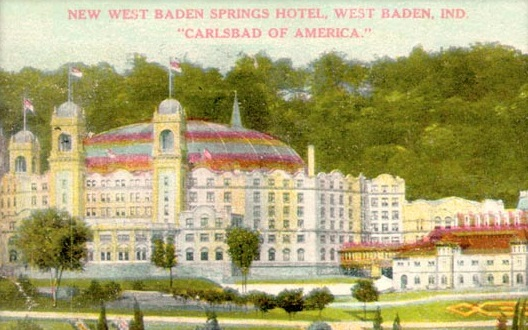
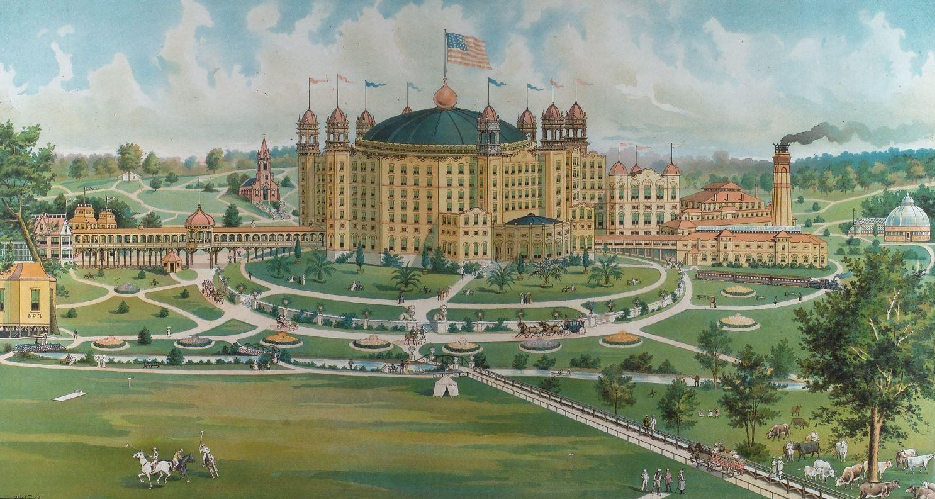
Hotel Timeline
The Location
For millennia, Native Americans used the area around the West Baden Springs Hotel as a hunting ground that was home to all sorts of wildlife. But following the arrival of French fur traders in the 18th century, the entire locale became known as “French Lick.” Shortly after the American Revolution, setters from the eastern United States began heading west into the region by wat of the Vincennes Trace, otherwise known as the “Buffalo Trace” for the herds of buffalo that once migrated along the trail. The first American to find the mineral springs was surveyor George Rogers Clark, who was camped nearly a mile away from the site in 1778. Word of his discovery spread to other immigrants traveling along the trace, who gradually built several villages and formed a township called “French Lick” in the early 19th century. Some of the earliest settlers desired to mine the salt licks that resided nearby, too, but Indiana’s territorial legislature forced them to stop when it was revealed that the saline content was too low. Nevertheless, people still settled the township. Among those who arrived was a physician named William A. Bowles, who established the French Lick Springs Hotel in 1845. His colleague, John A. Lane, then opened his own resort hotel—the Mile Lick Inn—near a small community one mile to the north of Bowles’ business. That little village eventually became known as “West Baden” after a similar spa town in Germany called “Wiesbaden.” West Baden and the surrounding villages within the township of West Baden continued to grow in interest throughout the remainder of the century, due to the presence of both the French Lick Springs Hotel and its rival, the West Baden Springs Hotel (formerly the Mile Lick Inn). Contributing to this rise in popularity was the Monon Railroad, which was an extension of the popular Chicago, Indianapolis, and Louisville Railway.
Unprecedented amounts of people flocked to the area to enjoy its wonderful resorts and relaxing minerals springs. French Lick’s popularity continued unabated among American travelers during the first few decades of the 20th century. Many of the nation’s most illustrious citizens frequently made trips out to French Lick, including the likes of actor John Barrymore, composer Irving Berlin, and gangster Al Capone. The area’s main resort hotels soon became central to the emerging culture of America’s Jazz Age, with exciting dance parties seemingly happening every weekend. But some of this luster disappeared when the Great Depression hit in 1929, as many of the resort businesses throughout the region struggled to attract the same numbers of guests. It took decades for French Lick and the other surrounding communities to return to their former glory as prestigious vacation retreats. Over the course of the 20th century, the entire area continued to emerge as one of the most fantastic places to vacation in the whole United States. It was during this development that the town’s most famous resident was born—legendary basketball star Larry J. Bird. Bird actually spent his infancy in neighboring West Baden Springs but moved south to French Lick during his adolescence. He would later go on to have a historic career playing for the Boston Celtics, becoming the only person in the National Basketball Association (NBA) to win the following awards: Rookie of the Year, Most Valuable Player, NBA Finals MVP, and All-Star MVP, as well as Coach of the Year and Executive of the Year. Larry Bird also won three NBA championships while playing for Boston, earning the coveted title in 1981, 1984, and 1986. Inducted into the Basketball Hall of Fame in 1998 for his career, Bird today is regarded as one of the sport’s most prolific figures.
The Architecture
The West Baden Spring Hotel’s appearance is a large result of the renovations that Lee Wiley Sinclair initiated in 1901, following an accident that befell the resort. In a bid to make the location even grander, Sinclair hired architect Harrison Albright of West Virginia to design the building. Just 20 years old, he defied the odds by constructing a wonderful structure that rested on a massive circular foundation. Queen Anne-style architecture was the most dominant form within the design, although elements of Moorish architecture appeared, too, as evidenced in the four towers that Albright constructed on the exterior. A crew of 500 men worked six days a week on ten-hour shifts in order to construct the gigantic resort hotel on time. In total, they spent nearly 270 business days working on the six-story West Baden Springs Hotel. Some of the finest amenities of the day were featured inside, including a casino, a billiard hall, and a bowling alley. A spacious theater also hosted nightly entertainment that ranged from operas to silent movies. Albright also created space for a bank and brokerage to service the resort’s upscale clientele. He also installed 500 guestrooms throughout the West Baden Springs Hotel. While the ground level featured the lobby, dining areas, meeting spaces, and administrative offices, the accommodations lined the halls of the second through fifth stories. Albright constructed the new guestrooms in concentric circles around the main atrium, in which the inner ring offered views of the hotel’s interior below. Some 40 guestrooms even had balconies that extended out toward the center of the hotel. Tiny by modern standards, the rooms initially had one or two twin beds and no private bathroom.
The atrium itself was incredibly spacious, as it was filled with a wealth of beautiful furniture. Known as the “Pompeian Court,” it was home to a huge fireplace and several palm trees that acted as the home to families of birds. But resting atop the atrium was a stunning 200-foot dome. The desire to top a building with a massive domed roof mirrored the conventional thinking of the day, which saw such grand displays of architectural prowess as artistic declarations. But no one expected the one proposed by Harrison Albright to be feasible. In fact, nearly all the building professionals in America believed that such a structure was incapable of standing. Yet, surprisingly, Albright proved them wrong. He hired a bridge engineer named Oliver Westcott to help him design the dome’s trusses. Made of steel and glass, it ultimately measured 195 feet in diameter and 130 feet in height. According to the U.S. Department of the Interior:
- Elliptical in configuration, the dome is supported by 24 steel ribs connected to a circular plate drum at the crown and tied together at the bottom by circular plate girders that rest only atop the hotel's outer walls at the circumference of the enclosed space. The ribs are supported on giant steel shoes provided with rollers to allow for metallic expansion and contraction.”
When guests finally viewed the dome, they were instantly amazed. Advertisements and newspapers articles quickly hailed the edifice as the “Eighth Wonder of the World.” Other architects from across the world traveled to the West Baden Springs Hotel just to investigate the dome’s unique structural design. The dome has since won numerous awards and designations. It has even influenced the way architects had designed similar domed structures, like the Superdome in New Orleans, the Georgia Dome in Atlanta, and the Astrodome in Houston.
Minor construction continued in the following decades, with Sinclair adding a large veranda in 1910, as well as a few alterations to the guestrooms. But when he died in 1916, his daughter and heir, Lillian, initiated a thorough series of renovations with her husband, Charles. While Charles opposed introducing any major changes to the resort, Lillian forged ahead, focusing her efforts on the atrium. She hired Italian artists to install a mosaic terrazzo of file flooring throughout the space, which consisted of two million squares of marble. Its grand fireplace was also refaced with glazed ceramic tiles, and marble wainscoting was affixed to the walls. While both the Jesuits and the Northwood Institute instituted their own various renovations to the site, the West Baden Springs Hotel remained largely the same in an architectural sense. True, the Jesuits had removed a significant portion of the fine details that Albright and the Rexfords instituted, but the historical integrity of the architecture was untouched.
Nevertheless, the next significant round of renovations occurred in the mid-1990s, starting with efforts by the National Trust of Historic Preservation and the Historic Landmarks Foundation of Indiana to save the building. During the decade prior, the West Baden Springs Hotel had decayed, as its ownership group—composed of H. Eugene MacDonald and Marlin Properties—fought over their internal financial grievances in court. Thanks, in part, to a mysterious donation of $70,000 from an anonymous patron, both the National Trust for Historic Preservation and the Historic Landmarks Foundation of Indiana managed to secure the structure of the resort. The two groups then received some temporary support in the form of Minnesota Investment Partners, which purchased the location from its bankruptcy receiver in 1994. It attempted to help with the renovations, but it quickly left the project when an unfavorable gambling bill passed in the state legislature. Minnesota Investment Partners eventually sold the West Baden Springs Hotel to HLFI West Baden—an affiliate of the Historic Landmarks Foundation of Indiana that had been organized for such a purpose. True salvation arrived in 1996, when the Historic Landmarks Foundation of Indiana struck a deal with the Cook Group to thoroughly restore the West Baden Springs Hotel. Bill and Gayle Cook of Bloomington, Indiana, were at the head of the company, and cared deeply for the preservation of historic buildings. Spending some $30 million dollars, the renovations took some three years to complete. Massive restorations occurred in every guestroom, as well as the dining spaces, the formal lobby, and the historic atrium. The Cooks then invested an additional $5 million to ensure that their hard work was preserved. The entire project was even filmed in a documentary called West Baden Springs: Save of the Century.
Over time, the Cook family fell in love with the West Baden Springs Hotel, of which they became the sole owners in 2006. HLIF West Baden had specifically deeded the facility in their name as a show of gratitude for the sacrifices they made to restore the resort. Inspired, the Cooks began another extensive period of restoration at the West Baden Springs Hotel that summer Lasting for a few months, the project reconfigured the West Baden Springs Hotel’s accommodations into 243 guestrooms and suites—a number that was fewer than half of the total within the original structure. But the Cooks had sacrificed quantity for quality, ensuring the that the spaces would rival the living quarters of any other contemporary destination. Furthermore, the resort’s natatorium was completely rebuilt, in which the architects used historical photographs as a guide. When all was said and done, the construction work had cost the Cook Group some $100 million! To guarantee that the architectural integrity of the West Baden Springs Hotel was always respected, the Cooks worked closely with the Historic Landmarks Foundation of Indiana. This relationship is forever preserved within a perpetual preservation agreement that will require any future owners to seek approval from the Historic Landmarks Foundation of Indiana for any future alterations, should any change in ownership occur. The cooperation between the two groups has also ensured that the West Baden Springs Hotel remain one of the most historic destinations of its kind in the entire United States.
Famous Historic Guests
- Eva Tanguay, actress and singer who is best remembered today as “The Queen of Vaudeville.”
- John L. Sullivan, boxer recognized to history as the first official heavyweight champion of gloved (modern) boxing.
- James J. Corbett, boxer and world heavyweight champion who brought an end to John L. Sullivan’s dominance of the sport.
- Joe Louis, world heavyweight boxing champion from 1937 to 1949 and regarded as one of the best to ever pursue the sport.
- Diamond Jim Brady, gangster active at the height of America’s Gilded Age.
- Al Capone, gangster infamously remembered as the head of the Chicago Outfit during Prohibition.
- George Ade, author, journalist, and playwright remembered for his plays, The Country Chairman and The College Widow.
- John J. Pershing, commanding general of the American Expeditionary Force during World War I.
- William “Big Bill” Hale Thompson, 41st and 43rd Mayor of Chicago (1915 – 1923; 1927 – 1931)
- Al Smith, 42nd Governor of New York (1923 – 1928) and rival of President Franklin Delano Roosevelt.
Film, TV and Media Connections
So Cold the River (2020)
Guest Historian Series

Hotel History: West Baden Springs Hotel (1902)*, West Baden, Indiana
In 1855, the town of Mile Lick, a mile north of the giant salt lick and springs in French Lick was renamed West Baden. In 1888, Lee Wiley Sinclair acquired controlling interest in the West Baden Hotel. Sinclair promoted his hotel as a cosmopolitan resort including a casino known as "The Carlsbad of America", an opera house, a two-deck covered oval bicycle and pony track. The Cincinnati Reds, Chicago White Sox, Chicago Cubs and Pittsburgh Pirates held their spring training in the area. Unfortunately, the entire resort and attractions burned down in 1901. Sinclair offered the West Baden to Tom Taggert, owner of the French Lick Springs Hotel but Taggert refused and instead expanded his hotel.
Lee Sinclair was rejuvenated by Taggert's rejection and embarked on a major construction project in an attempt to surpass the French Lick Springs Hotel. The major attraction of the new hotel was the circular building topped by a spectacular dome, designed by architect Harrison Albright which was the world's largest free-spanning dome until the Houston Astrodome in 1965. Later in his career Albright designed the U.S. Grant Hotel in San Diego, California.
CONTINUE READING