West Baden Springs Hotel
Golf
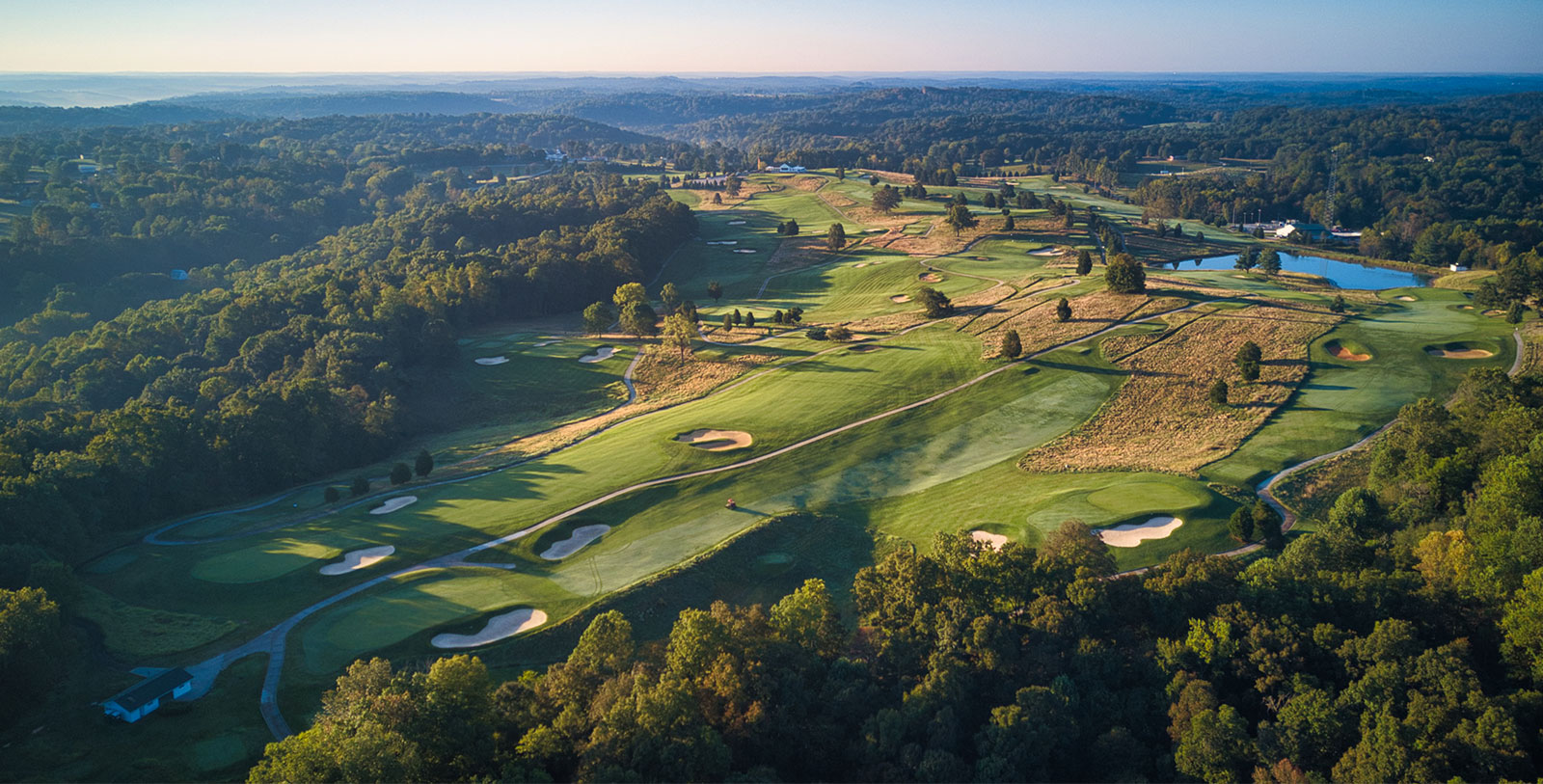
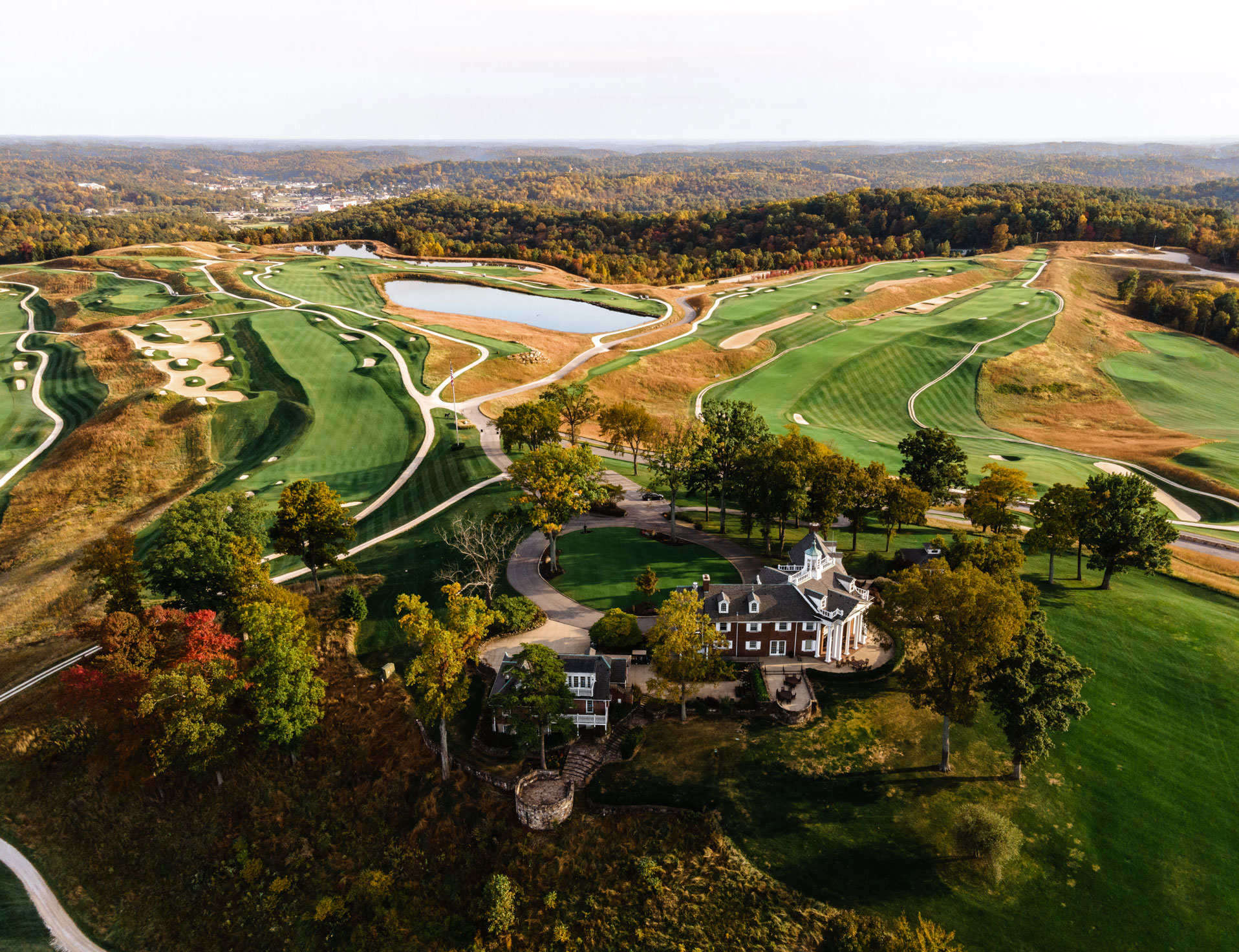
Discover both the Donald Ross Course and the Pete Dye Course – two famous sets of fairways that have hosted numerous PGA tournaments.
As part of the French Lick Resort, the West Baden Springs Hotel has access to four courses and 54 holes that span multiple eras of the sport. The French Lick Resort itself encompasses two historic hotels: The French Lick Hotel (opened in 1845 and inducted into Historic Hotels of America in 2000) and the West Baden Springs Hotel (opened in 1902 and inducted into Historic Hotels of America in 2015.) Guests at both have exclusive access to these four distinctive courses. Golf at the resort dates to 1907, when architect Tom Bendelow designed the first course for travelers and locals. His Valley Links Course has since been redesigned with families in mind; children 12 and younger can now play for free on the regulation length, nine-hole course. Then in 1917, Scottish immigrant and golf course architect Donald Ross designed a second Golden Age course to withstand the test of time. Today, The Donald Ross Course at French Lick has been restored to Ross’ original vision, with trademark flat-bottom bunkers and rectangular-shaped greens with sharp undulation.
One of the most memorable moments to transpire on the Donald Ross Course occurred when it hosted the 1924 PGA Championship, which was won by the legendary Walter Hagen. Hagen cemented a portion of his legacy as one of golf’s all-time greats with his PGA Championship victory at French Lick. It was the first of an unprecedented four straight PGA Championship titles for Hagen, and the sixth of his 11 major title victories overall. (That currently ranks him third all-time in pro golf, behind the 18 of Jack Nicklaus and the 14 of Tiger Woods.) Hagen earned it at a time when the PGA Championship format called for 12 rounds over six consecutive days, starting with a 36-hole stroke-play qualifier. The tournament then ended via a match-play format held over the last five days. Some of the pioneers of the early days of women’s golf also made their mark at French Lick, too, which hosted LPGA tournaments at the Donald Ross Course in 1959 and 1960. Betsy Rawls reigned over the field in 1959 to win the fourth of her eight major titles. Mickey Wright, who went on to claim 13 majors in her career, was the 1960 champion.
The resort has continued to expand with the new addition of Sand Creek, a short course introduced in 2025 that complements its championship layouts. This course was designed to provide a relaxed and approachable playing experience for all levels. Sand Creek incorporates elements inspired by the resort's renowned courses, offering guests another way to enjoy the game.
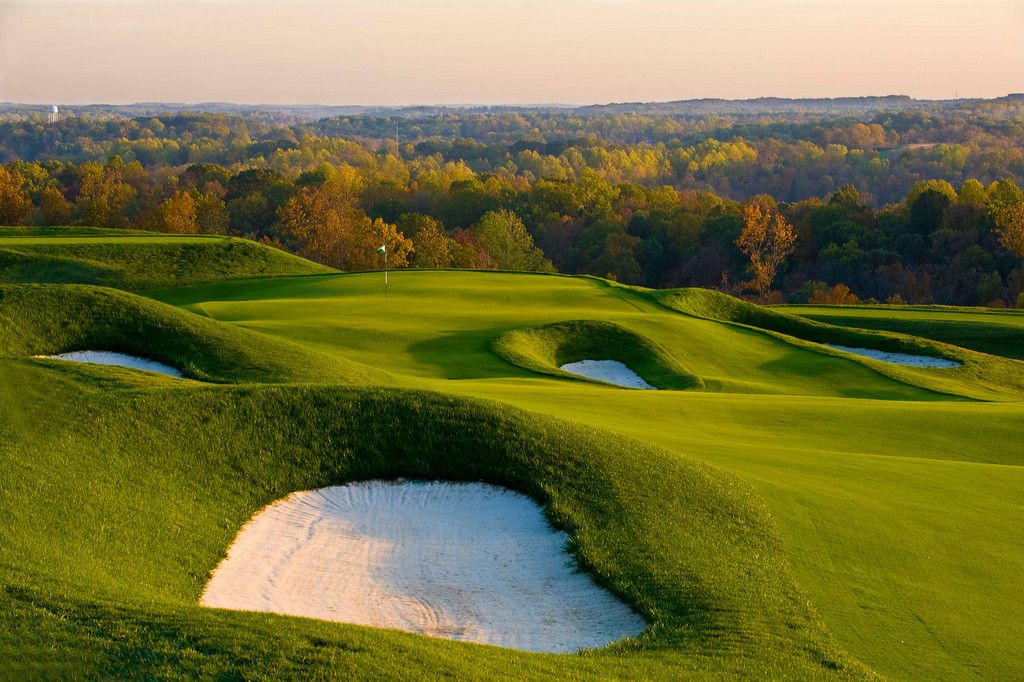
To complement the two historic courses, a third was added to the resort landscape a century later in 2009. Hall of Fame architect Pete Dye designed a hilltop masterpiece. Known for its 40-mile panoramic views and challenging layout, it played 8,100 yards from the back tees. Record-breaking Scottish professional golfer Colin Montgomerie called The Pete Dye Course “one of the iconic courses” in the United States after he won the Senior PGA Championship there in 2015. The course has also hosted Big Ten Conference Championships and Senior LPGA Championships. World-class golf has attracted scores of celebrities to French Lick over the years, including singer Bing Crosby, comedian Bob Hope, business magnate Howard Hughes, former Secretary of State Condoleezza Rice, and professional football player Peyton Manning. Even before he became basketball’s “Larry Legend,” French Lick native Larry Bird worked and played on the golf course in his youth. Guests of the West Baden Springs Hotel enjoy shuttle service between hotels and to the courses.
Golf Timeline
The Location
For millennia, Native Americans used the area around the West Baden Springs Hotel as a hunting ground that was home to all sorts of wildlife. But following the arrival of French fur traders in the 18th century, the entire locale became known as “French Lick.” Shortly after the American Revolution, setters from the eastern United States began heading west into the region by wat of the Vincennes Trace, otherwise known as the “Buffalo Trace” for the herds of buffalo that once migrated along the trail. The first American to find the mineral springs was surveyor George Rogers Clark, who was camped nearly a mile away from the site in 1778. Word of his discovery spread to other immigrants traveling along the trace, who gradually built several villages and formed a township called “French Lick” in the early 19th century. Some of the earliest settlers desired to mine the salt licks that resided nearby, too, but Indiana’s territorial legislature forced them to stop when it was revealed that the saline content was too low. Nevertheless, people still settled the township. Among those who arrived was a physician named William A. Bowles, who established the French Lick Springs Hotel in 1845. His colleague, John A. Lane, then opened his own resort hotel—the Mile Lick Inn—near a small community one mile to the north of Bowles’ business. That little village eventually became known as “West Baden” after a similar spa town in Germany called “Wiesbaden.” West Baden and the surrounding villages within the township of West Baden continued to grow in interest throughout the remainder of the century, due to the presence of both the French Lick Springs Hotel and its rival, the West Baden Springs Hotel (formerly the Mile Lick Inn). Contributing to this rise in popularity was the Monon Railroad, which was an extension of the popular Chicago, Indianapolis, and Louisville Railway.
Unprecedented amounts of people flocked to the area to enjoy its wonderful resorts and relaxing minerals springs. French Lick’s popularity continued unabated among American travelers during the first few decades of the 20th century. Many of the nation’s most illustrious citizens frequently made trips out to French Lick, including the likes of actor John Barrymore, composer Irving Berlin, and gangster Al Capone. The area’s main resort hotels soon became central to the emerging culture of America’s Jazz Age, with exciting dance parties seemingly happening every weekend. But some of this luster disappeared when the Great Depression hit in 1929, as many of the resort businesses throughout the region struggled to attract the same numbers of guests. It took decades for French Lick and the other surrounding communities to return to their former glory as prestigious vacation retreats. Over the course of the 20th century, the entire area continued to emerge as one of the most fantastic places to vacation in the whole United States. It was during this development that the town’s most famous resident was born—legendary basketball star Larry J. Bird. Bird actually spent his infancy in neighboring West Baden Springs but moved south to French Lick during his adolescence. He would later go on to have a historic career playing for the Boston Celtics, becoming the only person in the National Basketball Association (NBA) to win the following awards: Rookie of the Year, Most Valuable Player, NBA Finals MVP, and All-Star MVP, as well as Coach of the Year and Executive of the Year. Larry Bird also won three NBA championships while playing for Boston, earning the coveted title in 1981, 1984, and 1986. Inducted into the Basketball Hall of Fame in 1998 for his career, Bird today is regarded as one of the sport’s most prolific figures.
The Architect
Donald Ross: Few other golf course designers have had such an impact on the sport of golf than the legendary architect Donald Ross. Born in Dornoch, Scotland, Ross’ legendary career began when he apprenticed under Old Tom Morris at historic St. Andrews during the late 1890s. He harnessed several important skills from Morris that ranged from club maintenance to landscaping. Ross then used his education to parlay a job at the Royal Dornoch Golf Club near his childhood home. Unfortunately for Ross, the pay was abysmal. With the encouragement of Scottish expat named Robert W. Willson, Ross decided to try to find more rewarding work at one of the many new professional golf facilities that had started opening across the United States. Willson subsequently financed Ross’ trip across the Atlantic in 1899, who helped him settle down just outside of Boston, Massachusetts. Ross accepted a job as the resident golf pro at the Oakley Country Club, where he left an immediate impression upon its members. Word soon spread of his talents, which eventually attracted the attention of prominent businessperson James Walker Tufts. In the midst of developing the resort town “Pinehurst” within the North Carolina sandhills, Tufts decided to hire Ross to head the new settlement’s golf club. Ross headed south that winter, although not without some cajoling from friends who doubted the entire endeavor.
Nevertheless, Ross went to work in 1901, serving as the primary golf instructor for a single, 18-hole course created a few years prior by Dr. Leroy Culver and John Dunn Tucker. Ross decided to completely renovate its fairways after conferring with Tufts, thus jumpstarting the work on the future Pinehurst No(s). 1 – 4 over the next two decades. Over time, they quickly became the treasures that Tufts had originally envisioned. Their success further catapulted Ross’ reputation throughout the United States, inspiring many other destinations to hire him to design their respective courses. In all, Ross would create (and redesign) over 400 unique golf courses across the country, with some of his most notable being at the Seminole Golf Club, Oak Hill Country Club, and the Aronimink Golf Club. Ross was also commissioned by Tom Taggart to design a marvelous golf course that would help popularize French Lick. In 1924, Ross subsequently went to work creating a challenging, yet beautiful 124-acre course that featured 80 hazards square green with rolling pitches. Ross ultimately used the landscape to his advantage, too, building his fairways deep into the countryside. Debuting as the “Hill Course” in 1917, the complex earned the adoration of many golfers despite its level of difficulty. For more on Donald Ross’ famous course, please watch the following video from French Lick Resort here.
Pete Dye: Hailed as the most influential golf architect of the last half-century, architect Pete Dye has left a legacy on the golfing world. An avid golfer from a young age, Dye first played the sport competitively while in high school. He continued to golf when he enlisted in the United States military upon graduating. While stationed at Fort Bragg, Dye worked as the greenskeeper for the base’s golf course. He also met the prominent Donald Ross, who was then still serving as the main professional at Pinehurst Resort. The meeting greatly affected Dye’s passion for the game, which he kept following as a student at Rollins College. He subsequently met Alice Holliday O’Neal and the two were married not long thereafter. They eventually moved to her hometown of Indianapolis, Indiana, where he got a job selling policies with The Connecticut Mutual Life Insurance Company. Even though Ross thrived in insurance, he still loved golf dearly. He thus entered into numerous amateur championships in Indiana during the 1950s and built a considerable reputation for himself. He even used the experience to eventually compete in the 57th U.S. Open. Although Dye failed to advance deep in the tournament, he still finished ahead of future greats Jack Nicklaus and Arnold Palmer. In 1961, Dye decided to leave the insurance industry behind to pursue his passion for golf full-time. With close support of his wife, Dye specifically formed his own golf landscaping firm. Dye’s very first project involved creating a magnificent nine-hole course called “El Dorado,” which became notorious for its water hazards.
However, his first big project transpired when he obtained the commission to craft the marvelous 18-hole course at Crooked Stick Golf Club. Receiving rave reviews, Dye was soon earning numerous commissions all over the United States. Many of his designs soon became incredibly popular, including Harbour Town Golf Links, Whistling Straits, and the Ocean Course at Kiawah Island. His greatest accomplishment was the TPC at Sawgrass’ Stadium Course. Noted for its great difficulty, his par-three 17th hole has since been referred to as the “world’s most terrifying tee shot.” Much of Dye’s designs were inspired by Scottish design principles, namely the use of pot bunkers, wooden bulkheads, and small greens. But Dye also invented his own fascinating greenskeeping practices, too, such as the implementation of railroad ties to help hold down bunkers. Among the last courses that Dye designed was the complex that currently features his name at French Lick Resort. Initially crafted on a napkin by Dye, the course contained many of his hallmark design elements. In the words of the professionals at French Lick Resort: “This championship golf course on one of Indiana’s highest elevation points has narrow, immaculate fairways and rugged, intense terrain.” Furthermore: “The Pete Dye Course has gained national acclaim for its 40-mile panoramic views of the southern Indiana countryside, three man-made lakes, ‘volcano’ bunkers and a variety of elevation changes. A robust 8,100 yards from the professional tees punctuate Dye’s signature sting from vista to vista.”
Famous Historic Tournaments
7th PGA Championship (1924): By the early 1920s, Walter Hagen was rapidly emerging as one of the most important figures in the world of golf. He had already won four major championships to that point—the Open Championship, the PGA Championship, and two U.S. Opens. His success had also done much to professionalize the sport, with his victories gaining a large international fanbase. As such, private clubhouses across the world became more open to accommodating visiting professionals whenever a PGA Tour event was held on-site. While Hagen’s skills were already well documented by this point, his victory at the 7th PGA Championship was among his greatest victories. Playing on the difficult Hill Course at the French Lick Springs Hotel, Hagen proceeded to dominate the competition. On the final round of play, he paired up with talented British golfer Jim Barnes for the title. Playing a pitched match, Hagen masterfully beat Barnes on the final, 36th hole of the two-round competition. Hagen’s victory would be the first of five consecutive first-place finishes at the PGA Championship—a record that only Jack Nicklaus has reached since then.
5th LPGA Championship (1959): The year 1959 would prove to be Betsy Rawls most successful while competing as a pro on the LPGA’s circuit. By the end of the year, Rawls would have won ten different titles—the most at any other point throughout her entire career. In fact, Rawls had the lowest scoring average of any female golfer in the LPGA, resulting in her winning the coveted LPGA Vare Trophy. One of her most memorable victories came when competing at the 5th LGPA Championship, held on the French Lick Springs Hotel’s Hill Course. Rawls played one of her best games, shooting a total of 144 throughout the whole tournament. Her performance on the second day is what would truly go down in history. Paired with the accomplished Patty Berg, Rawls shot a record-setting 68 to win the title. Indeed, the feat was even more astounding given the terrible weather that had impacted the course the day prior. But Berg herself had a historic showing, too. As testimony to her skill, she had managed to keep up with Rawls throughout the whole contest, barely losing to her by a single stroke. Fans of the game have since remembered their duel as the most enjoyable to watch in the history of the game.
6th LPGA Championship (1960): Hot of her victory at the previous year’s LPGA Championship, Betsy Rawls attempted to defend her title at the 6th LPGA Championship. Returning to the Hill Course, the tournament was held in early July. The field was crowded with competitors vying to take Rawls’ title, such as Fay Crocker, Marlene Hagge, and Patty Berg. While all those women would all complicate Rawls’ ability to win again, her toughest competition came from Louise Suggs and Mickey Wright. Both Suggs and Wright were incredibly talented themselves, having won a combined 14 major championships to date. Suggs was much more of a veteran than Wright, however, with 11 major titles under her belt. But when the leader board came into focus on the final day, it was Mickey Wright who had pulled ahead of both Suggs and Rawls. Shooting four under par, Wright had a three-stroke lead over Suggs and a nine-stroke lead over Rawls. As such, Wright walked away with her second of four LGPA Championships, as well as a considerable purse of $1,500. Wright would subsequently win nine more major championships until her eventual retirement in 1969.
Famous Historic Golfers
- Donald Ross, golf course architect responsible for creating and redesigning around 400 courses throughout his lifetime.
- Pete Dye, golf course architect responsible for creating such renowned courses like Harbor Town Golf Links and TP at Sawgrass.
- Walter Hagen, winner of 11 major golf championships, including the U.S. Open, the British Open, and the PGA Championship.
- Gene Sarazen, winner of seven major golf championships that include the U.S. Open, the British Open, the PGA Championship, and the Masters Tournament.
- Louise Suggs, winner of 11 major golf championships that include the Western Open, the Titleholders Championship, the Women’s PGA Championship, and the U.S. Women’s Open.
- Betsy Rawls, winner of eight major golf championships that include the Western Open, the Women’s PGA Championship, and the U.S. Women’s Open.
- Patty Berg, winner of 15 major golf championships that include the Western Open, the Titleholders Championship, and the U.S. Women’s Open.
- Mickey Wright, winner of 13 major championships that include the Western Open, the Titleholders Championship, the Women’s PGA Championship, and the U.S. Women’s Open.
- Bob Hope, comedian and patron of the United Service Organization (USO).
- Bing Crosby, world-famous singer and actor known for his roles in Going My Way and The Bells of St. Mary’s.
- Howard Hughes, business magnate and pilot best known for creating the Hughes Aircraft Company in 1932.
Women in Golf
Louise Suggs: Enshrined in the World Golf Hall of Fame, Louise Suggs is credited today with founding the modern Ladies Professional Golf Association (LPGA). But her history in the sport harkens much further back to her youth when she first began winning competitions as a teenager. Her successes continued well into adulthood, winning three North and South Women’s Amateur titles. Furthermore, her early career saw victories at the U.S. Women’s Amateur, the Titleholders Championship, and the Women’s Western Open. After winning numerous tournaments, Suggs eventually formed the LPGA alongside 12 other colleagues for female golfers who wished to turn professional. Indeed, some of her cofounders were two of her biggest rivals at the time, Babe Zaharias and Patty Berg. Following its creation, Suggs became one of the organization’s greatest winners, acquiring the titles to several major championships. In addition to winning more Titleholders Championships and Women’s Western Opens, (which had now become a part of the LPGA’s main circuit), Suggs also won the U.S. Women’s Open and the Women’s PGA Championship. In fact, Suggs became the first professional female golfer to have a career grand slam, following her victory in the 1957 Women’s PGA Championship. In honor of her renowned accomplishments, Suggs was inducted into the World Golf Hall of Fame in 1951.
Betsy Rawls: A member of the World Golf Hall of Fame, Betsy Rawls was one of the most successful female professional golfers to play the sport. Born in 1928, her passion for the game began as a teenager. She subsequently won numerous amateur titles in 1949 and 1950, including the Texas Amateur, the Trans-National, and the Broadmoor Invitational. In fact, Rawls finished second in the 5th U.S. Women’s Open! Upon turning professional in 1951, Rawls rapidly built a national reputation following her victory at the Sacramento Women’s Invitational Open. From there, Rawls would win 55 other tournaments as part of the LPGA Tour, including eight major championships. One of her most memorable triumphs transpired while competing at the 5th LPGA Championship in 1959. Held on the Donald Ross Course at French Lick Springs Hotel, Rawls played an incredibly memorable match against one of the world’s best golfers, Patty Berg. Remaining neck-and-neck, Rawls barely beat out Berg by a single stroke. Rawls’ influence over the sport became great. Indeed, she eventually served as the LPGA’s President during the early 1960s. Rawls was even immortalized in the LPGA Tour Hall of Fame in 1967, becoming one of its six inaugural inductees. Few other professional golfers have truly had as much impact on the sport as Betsy Rawls.
Patty Berg: A founding member of the LPGA, Patty Berg first picked up golf at the suggestion of her parents in 1931. A natural athlete, she quickly became an accomplished golfer. Indeed, Berg began competing as an amateur a mere three years later! First winning the Minneapolis City Championship, Berg soon won titles at the U.S. Women’s Amateur, the Women’s Western Amateur, and three consecutive Titleholders Championships. After winning a total of 29 amateur titles, Berg decided to turn professional. However, Berg suffered a terrible automobile accident that nearly ended her career. But she made her triumphant return during World War II, in which she won the Women’s Western Open again. From there, Berg would win 55 more tournaments, including several major competitions. Not only would Berg come in first at five more Women’s Western Opens, but she also walked away as the top golfer at the Titleholders Championship four more times, too. Berg’s successes did not stop there though, as she won the Women’s PGA Championship twice in 1956 and 1959, as well as the U.S. Women’s Open in 1946. Her accomplishments made her one of the most recognized female golfers in the sport by the mid-20th century. In fact, her clout earned her much praise throughout the country, in which she received the Bob Jones Award and the Old Tom Morris Award. In 1978, the LPGA even established its own trophy in her honor—the Patty Berg Award. Today, Patty Berg is commemorated in the World Golf Hall of Fame.
Mickey Wright: One of the most celebrated inductees into the World Golf Hall of Fame, Mickey Wright dominated the golfing world for much of the 20th century. Like many of her other colleagues, Wright’s fascination with the game began at an early age. Her transition to competitions began during the 1950s though, after attending a single year at Stanford University. (She even played for the school’s golf team for a time.) Her first victory came in 1952 when she won the United States Golf Association’s U.S. Girls’ Junior circuit. She then competed in both the World Amateur Championship and the U.S. Women’s Amateur two years later, finishing first and second, respectively. Encouraged by her own success, she turned professional shortly thereafter. Wright subsequently joined the LPGA in 1955 and proceeded to win 82 events throughout the course of her career—making her second on the all-time win list. Her greatest victories occurred at the LPGA’s major championships, where she won 13 titles. One of her most memorable victories transpired at the 6th Women’s PGA Championship, which was held on The Donald Ross Course at the French Lick Springs Hotel. Wright played masterfully, shooting three strokes ahead of Louise Suggs. Perhaps even more surprising was her dominance over the previous year’s winner, Betsy Rawls, who had finished nine strokes back. While Wright eventually retired early in 1969, her legacy has nonetheless endured for generations. Indeed, numerous contemporary publications—including Golf Digest and Golf Magazine—have rated her as among the top ten best golfers to ever play the sport.