
History
Discover The Broadmoor, which offers exceptional accommodations among the mountains of Colorado Springs, Colorado.
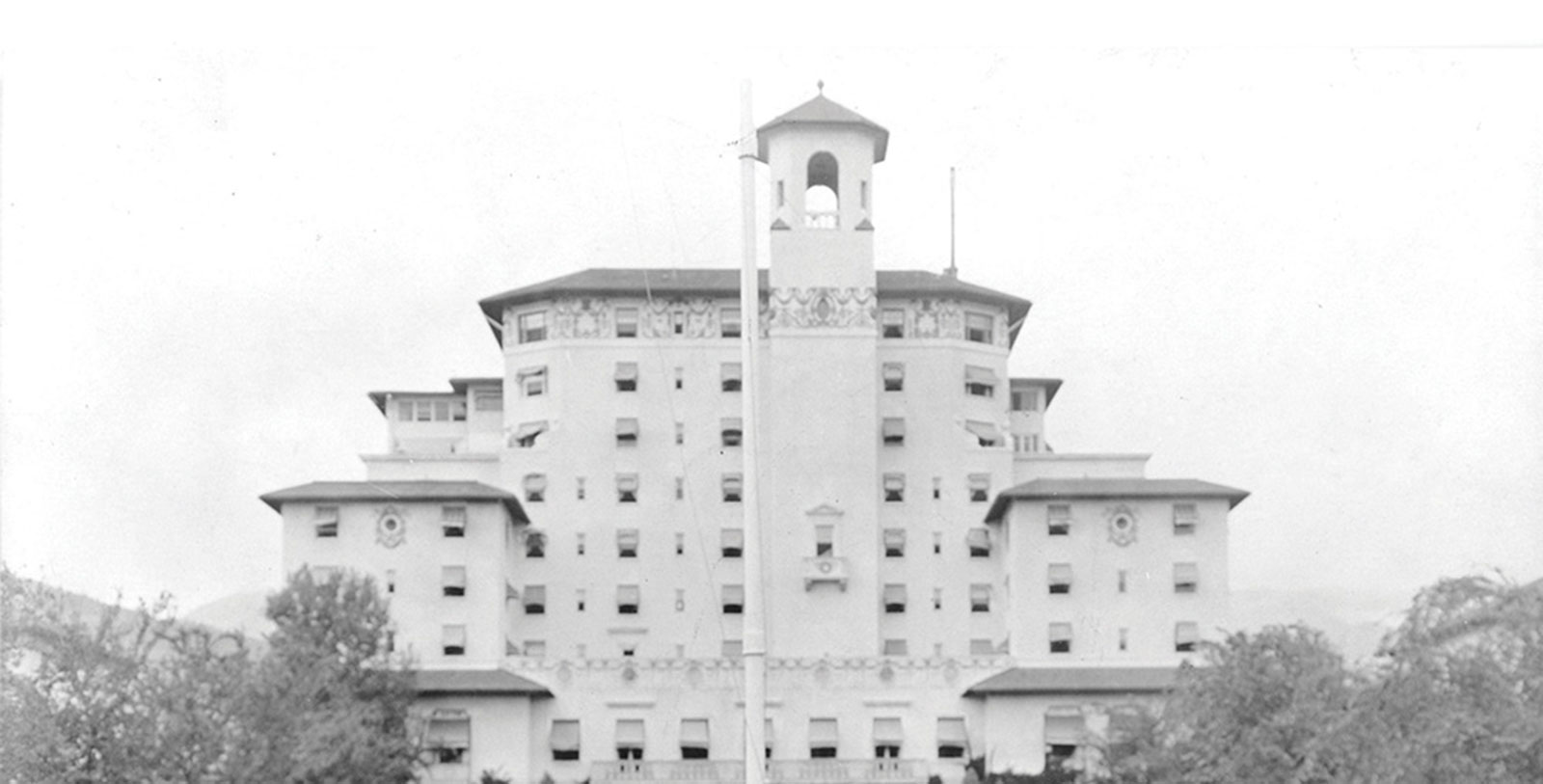
The Broadmoor was constructed during the international conflict of 1914 to 1918, where the Central Powers battled the Entente for global dominance. In 1880, tuberculosis patient Willie Wilcox came west seeking his fortune and hoping to find a cure for his illness. He bought the land at the base of Cheyenne Mountain and established a small dairy farm, but his inexperience with animals became his undoing. Wilcox formed a partnership with a Prussian Count named James Pourtales, who had also come west to seek romance and fortune. Pourtales had grand designs and decided the only way to make a truly decent profit was to create an upper-class suburb of Colorado Springs with numerous amenities. As such, The Broadmoor Land and Investment Company was born in 1890. To entice buyers, Pourtales built the original Broadmoor Casino and Cheyenne Lake. After going bankrupt when the casino burned down, Pourtales sold the land to a group of investors who built a second casino and a small hotel. Plagued with similar problems, the second casino and the hotel went into receivership. Purchased by a prominent Colorado Springs investor, the hotel and casino became The Broadmoor School for Girls, a private boarding school.
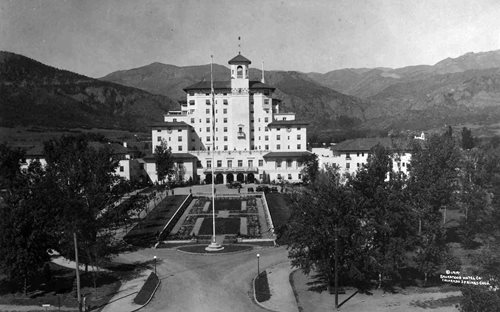
On May 9, 1916, Spencer Penrose, a Philadelphia entrepreneur who had made his fortune in mining, purchased the casino, hotel, and an adjoining 450 acres. His dream was to turn the Pikes Peak region into the most interesting, multi-faceted resort area that could be imagined. The New York firm of Warren and Wetmore designed the structure and construction began on May 20, 1917. Skilled artisans were brought from Europe to create The Broadmoor's elaborate moldings, embellishments, and paintings. To further enhance its renown, Penrose also hired famed Scottish golf architect Donald Ross to create the hotel’s 18-hole golf course. When the project finally concluded in 1918, Penrose and his fellow investors had spent more than two million dollars (which is the equivalent to $34 million today). It was nevertheless received as one of the best resorts in the entire United States. Penrose threw a magnificent extravaganza to commemorate The Broadmoor’s grand opening, starting a legacy of world-class hospitality that was to last for more than a century. Within a matter of years, all sorts of prestigious Americans would stay at The Broadmoor at one point or another, including John D. Rockefeller, Charles Lindbergh, and Clark Gable. It even hosted numerous U.S. Presidents, such as Herbert Hoover and Franklin Delano Roosevelt.
When Penrose passed away in 1939, his charitable organization, El Pomar Foundation, assumed control over The Broadmoor. The organization subsequently appointed Charles L. Tutt Jr. of the Broadmoor Hotel and Land Company as the resort’s president. Under the stewardship of Tutt—and his sons William and Russell—The Broadmoor grew exponentially. Several new facilities emerged on site, including the luxurious Broadmoor South and the International Center. They oversaw the design of two additional golf courses as well, including one developed by the legendary Arnold Palmer. In spite of this success, El Pomar Foundation eventually sold The Broadmoor to The Oklahoma Publishing Company in 1988. Now owned by the Anschutz family, The Broadmoor today continues to be one of the nation’s most prestigious historic destinations.
Hotel Timeline
The Location
The Broadmoor resides within the Broadmoor neighborhood, which in turn lies within the city limits of Colorado Springs. Affiliated with Colorado Springs as far back as the late 19th century, this bucolic district was only recently annexed by the city in 1980. Yet, the Broadmoor neighborhood is still a part of the rich heritage that defines the Old American West. Colorado Springs itself dates back to 1886 when William Jackson Palmer of the Colorado Springs Company founded the settlement as part of a much larger strategy to establish communities that would service his future railroads in the area. The city spent the first year of its existence as the “Fountain Colony” before changing its name permanently to “Colorado Springs.” The Broadmoor neighborhood emerged around this time, when developers working of the Broadmoor Land Company constructed the suburb for those working in the adjacent settlement. Mining and railroad companies dominated the local economy for decades until the mid-20th century when several military commands—including the North American Aerospace Defense Command (NORAD)—moved to the area. Many wonderful outdoor geographic locations surround both the Broadmoor neighborhood and Colorado Springs as a whole, with the northern spur of Cheyenne Mountain located close to the resort.
The Architecture
Modeling his fledgling resort after the great alpine hotels of 19th-century Europe, Spencer Penrose had always intended for The Broadmoor to be the unrivaled “Grand Dame of the Rockies.” Enlisting the help of two investors, Albert E. Carlton and C.M. MacNeill, he spared no expense in The Broadmoor’s development. Penrose hired the architectural firm Warren and Wetmore to oversee the design, which had risen to prominence for its prior work with the Ritz-Carlton and Bowman-Biltmore hotel chains. He also recruited the renowned landscape architect, Frederick Law Olmstead Jr., to create the layout of the grounds, and charged Donald Ross to craft The Broadmoor’s first golf course. Priceless pieces of furniture and artwork were imported directly from both Europe and Asia, while facilities for the first ever full-service spa emerged amid the construction. Penrose even transported a dismantled pub from England and reassembled it as a dining option inside The Broadmoor.
When the project finally concluded in 1918, Penrose and his fellow investors had spent more than two million dollars (which is the equivalent to $34 million today). It was nevertheless received as one of the best resorts in the entire United States. Many marveled at its brilliant architectural design, which borrowed heavily from the aesthetics of the Italian Renaissance. Warren and Wetmore crafted an incredibly iconic exterior of pink stucco that enabled The Broadmoor to blend in seamlessly with the surrounding mountains of Pikes Peak. Inside, guests encountered a wealth of beautiful architectural features, including the gorgeous ceiling over the main lobby’s mezzanine. Designed by Giovanni Smeraldi and a team of 100 Italian artists, the structure displays two masterfully painted images of dancing cherubs.
Construction to The Broadmoor did not cease after its initial opening though. On the contrary, Penrose continued to grow the resort well after its grand debut. He oversaw the construction of a large polo field in 1928, as well as the Broadmoor Riding Arena across from the main building two years later. Penrose also initiated the development of the Broadmoor Ice Palace in 1938, which hosted several U.S. Figure Skating Championships throughout the mid-20th century. Yet, the work on The Broadmoor continued well after Penrose’s death in 1939. Thanks in large part to his widow, Julie, as well as the family charitable organization, El Pomar Foundation, the resort continued to grow. Together, they established the Carriage House Museum to honor Spencer Penrose’s legacy. Additional facilities were added throughout the 1950s and 1960s, including the creation of Broadmoor South and the International Center. More recently, The Broadmoor has seen the addition of many new structures, including the Broadmoor Golf and Tennis Club, the Broadmoor Golf Club, and most notably, Broadmoor West.
Over the years, The Broadmoor’s magnificent landscape architecture has come to be just as iconic as its structural architecture. Originally designed by Fredrick Law Olmstead Jr., the resorts gardens currently cover some 35 acres. The landscaping and flowering gardens encourage guests to experience several different types of landscape, and the original European theme throughout the resort. As guests drive up the entrance to the main hotel, they view a formal garden with the hedged boxwoods and junipers and a water feature with water lilies blooming on top of the water surrounding the 10 acre lake. In the spring time, over 18,000 daffodils and 25,000 pansies are planted. In the summer there are over 35,000 annual and 12,000 plants scattered in pots and hanging baskets around the resort.
Famous Historic Events
The Broadmoor has accommodated its fair share of international sporting competitions throughout its history. Dozens of U.S. Women’s Open and U.S. Senior Open golf tournaments have happened at the resort ever since they both started. It has also served as the venue for several U.S. National Figure Skating Championships from 1948 to 1973. It was even the host for the World Figure Skating Championship in 1965, in which Alain Calmat of France won the Men’s Gold; Petra Burka of Canada won the Ladies’ Gold; Liudmila Belousova and Oleg Protopopov of the Soviet Union won the Pairs’ Gold; and Eva Romanová and Pavel Roman of Czechoslovakia won the Gold in Ice Dance. Several Americans do receive Silver medals in the following categories: Scott Allen in the Men’s competition, as well as Vivian Joseph and Ronald Joseph in the Pairs competition.
The resort was also the meeting place for a North Atlantic Treaty Organization (NATO) summit back in 2003. Then President George W. Bush and his Secretary of Defense, Donald Rumsfeld, met with allies from seven European countries at The Broadmoor to discuss the nature of their alliances through the NATO agreement. NATO is a multinational alliance of nations in North America and Europe, which seek to defend one another in the event of an attack. This historic relationship formed in the wake of World War II, when several nations—led by the United States—signed the North Atlantic Treaty in 1949. Many Western nations at the time worried that the Cold War with the Soviet Union could become “hot” and sought out each other’s mutual protection.
Famous Historic Guests
- John D. Rockefeller, founder of Standard Oil Company
- Charles Lindbergh, historic aviator and military officer
- Clark Gable, actor known for his roles in It Happened One Night, Mutiny on the Bounty, Gone with the Wind.
- John Wayne, actor known for his roles in The Man Who Shot Liberty Vance, True Grit, and The Longest Day.
- Maurice Chevalier, actor known for his roles in The Love Paradise and The Smiling Lieutenant.
- Bing Crosby, actor, singer, and comedian who many consider to be America’s first multimedia star.
- Walt Disney, legendary founder of The Walt Disney Company.
- Bob Hope, famed comedian and patron of the United Service Organization (USO).
- Jimmy Stewart, actor known for his roles in You Can’t Take It with You and Mr. Smith Goes to Washington.
- Jack Benny, famous comedian known for his trademark comic timing.
- Jackie Gleason, legendary comedian known for starring in The Jackie Gleason Show.
- Joe DiMaggio, celebrated baseball player known as “The Yankee Clipper.”
- Stan Musial, franchise icon of the St. Louis Cardinals.
- Prime Minister Toshiki Kaifu of Japan (1989 – 1991)
- Margaret Thatcher, Prime Minister of the United Kingdom (1979 – 1990)
- Herbert Hoover, 31st President of the United States (1929 – 1933)
- Franklin D Roosevelt, 32nd President of the United States (1933 – 1945)
- Dwight David Eisenhower, 34th President of the United States (1953 – 1961)
- John F. Kennedy, 35th President of the United States (1961 – 1963)
- Richard M. Nixon, 37th President of the United States (1969 – 1974)
- Gerald Ford, 38th President of the United States (1974 – 1977)
- Ronald Reagan, 40th President of the United States (1981 – 1988)
- George H.W. Bush, 41st President of the United States (1989 – 1993)
- George W. Bush, 43rd President of the United States (2001 – 2009)
Film, TV and Media Connections
- Ice Castles (1978)
- The Case of the Sinister Spirit (1987)
Guest Historian Series
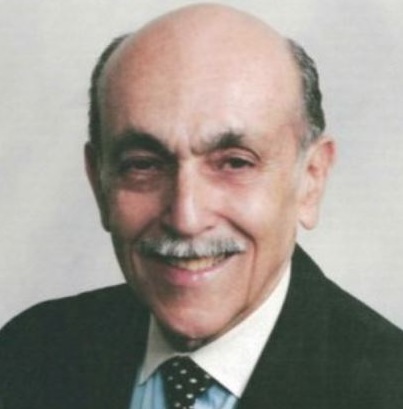
For over a century, dreamers, farmers, investors, and even a Prussian Count have held a vision of the magnificence in store for the Colorado Springs area. It took the foresight, dedication and incredible vision of one man, Spencer Penrose, to bring the dream to reality… and to make it wonderful enough to last 100 years.
Even before it was the Broadmoor Dairy Farm, the land at the base of Cheyenne Mountain was a ranch where corn was grown for making brooms. Willie Wilcox, who came to the area seeking his fortune and hoping to find a cure for his tuberculosis, bought the land in 1880 and established a small dairy. Unfortunately, Wilcox’s inexperience with animals soon became evident, and he realized that without significant investments the project would not be a success, so he began negotiations to sell the land.
Continue Reading