
History
Discover the Omni Bedford Springs Resort with its stone foundation and restorative mineral springs.
A National Historic Landmark, the Omni Bedford Springs Resort is one of the nation’s few surviving historic resort hotels. Its story began with John Anderson, a doctor practicing in the town of Bedford, Pennsylvania, in the late 1700s. He had come to learn of seven mineral springs located just beyond Bedford’s borders that supposedly possessed significant medicinal qualities. Legends abounded of how Native Americans had long ventured to those sanguinary bodies of water to heal themselves of various physical and mental ailments. As such, Anderson sought to establish an intricate medical facility on the site so to better treat the illnesses of his patients. In 1796, he purchased the 2,200-acre stretch of land upon which the mineral springs resided from Nicholas Shauffler. Anderson originally constructed a series of rudimentary bathing facilities near the wells, which attracted weary travelers venturing west toward the frontier. Interest in Anderson’s roadside attraction seemed to explode overnight. Demand proved to be so great that he decided to erect a few more sophisticated buildings within a matter of years. By 1809, there were three permanent structures that offered overnight accommodation, the greatest being that of the Stone House. These facilities greatly impressed their guests, for they possessed such novel amenities as a billiard hall and exclusive bathrooms. Over time, the mineral springs were collectively referred to as the “Bedford Springs,” with Anderson’s business becoming the “Bedford Springs Resort.”
The reputation of Dr. Anderson’s secluded retreat only grew as the 1800s progressed. Stagecoach travel from the eastern seaboard picked up over the next two decades, as newly constructed thoroughfares—such as the Chambersburg Turnpike and the National Road—connected the resort more directly with the nation’s major population centers. The destination became particularly prevalent among the social elite living around the District of Columbia, which was just a day or two away from Bedford. One of the first guests to vacation at Anderson’s business was an aging Thomas Jefferson in 1819. His arrival marked the beginning of a celebrated tradition, in which various 19th-century U.S. presidents sojourned out to the location. The president who visited the most was Pennsylvania’s own James Buchanan, who served as President of the United States from 1857 – 1861. Referring to the destination as his “Summer White House,” Buchanan conducted much of his official business inside the resort. Some of those activities included hosting Nicaragua’s foreign minister, as well as presiding over the passage of the Lecompton Constitution. He even participated in the first ever transatlantic telegraph in 1858, in which Queen Victoria of the United Kingdom expressed her deep admiration for the historic relationship between their two nations. Yet many other important political figures—including senators and federal judges—routinely traveled out to the Anderson family resort in order to bask in its tranquil mineral spring water.
As the location’s popularity grew, so too did the size of its grounds. Starting with the iconic Colonial Building in 1829, the Anderson family constructed many new facilities over the next six decades. The greatest of these structures was the historic Swiss Cottage and the first iteration of the massive Kitchen Building. They also thoroughly renovated the existing structures, including a $170,000 facelift of The Stone House. Landscape improvements included establishing a magnificent garden as well as a tree-lined gavel path that directed guests toward the resort’s main campus. The construction work continued even after the Bedford Springs Resort fell into a period of fluid ownership that started in 1887. When the Baltimore and Ohio Railroad and its competitor, the Pennsylvania Railroads, built train stations nearby, for instance, its owners constructed two new magnificent lodgings known as the “Evitt House” and the “Anderson House.” They also initiated a massive, $100,000 renovation of the entire resort that culminated with a major overhaul of the Colonial Building in 1903. Much of this construction coincided with the resort’s golden years, which saw the entire business hailed as the “gold standard” for similar operations. Dozens of spectacular colorful houses dotted its landscape as crowds of guests jovially lurched from one mineral spring to the next. It even became the sight of a nationally renowned, three-week-long holistic therapy called the “Bedford Cure.”
Yet, this prolonged period of prosperity was not to last. The economic onslaught of the Great Depression greatly diminished demand for the resort’s services, which put it in dire financial straits. Its recovery took longer than expected when it was requisitioned by the United States military at the outbreak of World War II. Within weeks of the Attack on Pearl Harbor, the United States Navy established a naval radio operating school within the resort’s facilities. By the time the school closed in 1944, over 6,000 sailors had received extensive training at the Bedford Springs Resort. The training regime was tough, necessitating the completion of a harrowing program that took 20 weeks to finish. The Navy greatly renovated the building to suit its needs, too, focusing on updating the kitchen facilities, as well as the accommodations at the Colonial Building, The Stone House, the Swiss Cottage, the Evitt House, and the Anderson House. Many of the guestrooms were even transformed into administrative offices, as many buildings throughout the entire resort became the nucleus of a vibrant administrative complex. Once the Navy vacated the premises, officials with the State Department employed the resort to house high-level Japanese diplomats that were captured in Germany in the spring of 1945. Among the most noteworthy of the interned diplomats was General Hiroshi Ōshima, the Japanese Ambassador to Germany. Most of the diplomats were kept inside the new Barclay House, which the resort’s managerial team had originally constructed in 1924.
Like many other mineral springs still in operation by the mid-20th century, the Bedford Springs Resort experienced a continued decline in its business. But thanks to its national prominence—as well as its proximity to the heavily traveled Pennsylvania Turnpike—the resort managed to keep its doors open for some time. One of the major developments that helped distinguish it from similar resorts was its debut as a year-round facility in 1950. The resort’s historic elegance still managed to attract the leading influential figures from the nation’s capital, as well, including the likes of President Dwight D. Eisenhower toward the end of his second term in office. Ronald Reagan also frequented the Bedford Springs Hotel on occasion, with his first visit occurring while he was serving as the Governor of California in 1975. A series of poor business decisions ultimately undermined the resort’s financial stability, which led to its demise at the end of the 1980s. After sitting dormant for the better part of a decade, a local company known as “Bedford Resort Partners Limited” acquired the facility for a sum of $8 million. The entity subsequently invested millions more into rehabilitating the Bedford Springs Resort back to its former glory. Like a phoenix rising from the ashes, the resort once again opened its doors to great acclaim in 1998. Today, this wonderful historic destination is part of the Omni Hotels and Resorts family and operates as the “Omni Bedford Springs Resort.” A member of Historic Hotels of America since 2007, the Omni Bedford Springs Resort is one of the best places to vacation in the entire United States.
Hotel Timeline
The Location
The Omni Bedford Springs Resort is actually recognized by the U.S. Department of the Interior as both a National Register of Historic Places District, as well as a National Historic Landmark District. As such, the entire facility is protected by the federal government for its significant historical properties. The U.S. Department of the Interior identified some 23 different locations on-site that ultimately contributed to the historical nature of the resort in some fashion. Those structures are spread across 300-acres of land in a narrow valley formed by a tranquil creek called, “Shober’s Run.” The resort itself was developed around seven, historic mineral springs that are still known today as “Black,” “Crystal,” “Iron,” “Limestone,” “Magnesia,” “Sulphur,” and “Sweet,” While all seven of the springs ingratiated themselves among the resort’s earliest patrons, there was one that stood out above all the rest—the Magnesia Spring. Guests could originally access this well over at Constitution Hill, which is located close to the Colonial Building and Shober’s Run. The Anderson family constructed a Greek Revival-themed spring house for the body of water, although it was later removed in 1987. Many additional facilities reside over a Federal Hill, including most of the resort’s lodgment buildings.
The whole facility resides along U.S. Route 220, which cuts through the heart of Bedford, Pennsylvania. Now a borough for the eponymous Bedford County, it was first settled in the mid-1700s by colonial settlers heading west into the Allegheny Mountains. One of the most historic events to transpire within the town occurred shortly after the American Revolution, when President George Washington arrived in Bedford to put down the Whiskey Rebellion. The uprising had spawned among angry distillers in western Pennsylvania, who had become incensed by a new national tax on liquor that sought to pay off the country’s war debt. Whiskey was essential to life for small farmers in the region, as it was used as a form of currency at a time when printed money was scarce. The distillers attacked local officials in response to the law, and eventually burned the home of the area’s main tax inspector in July 1794. After several days of fruitless negotiations, President George Washington led an army out to western Pennsylvania in order to quell the movement. Fortunately, no blood was shed and resistance to the new tax dissipated in the face of such overwhelming force. While critics such as future President Thomas Jefferson were alarmed with the show of government strength, Washington’s supporters agreed that it was a necessary step in establishing federal power throughout the young United States.
The Architecture
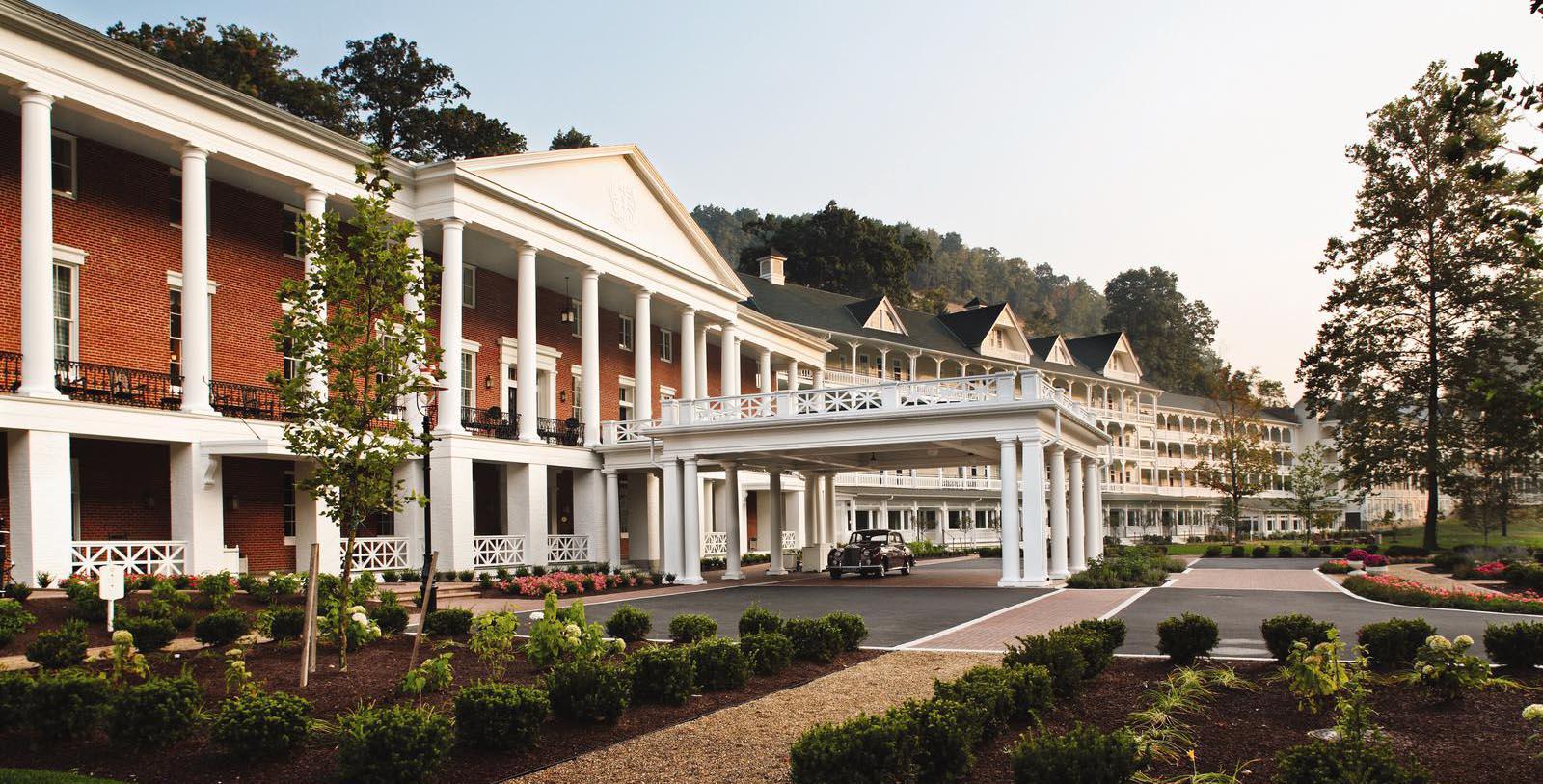
Developed gradually from 1806 and 1924, The Omni Bedford Springs is a brilliant, yet rare, example of an American spa resort from the 19th and early 20th centuries. Its main facility is the Greek Revival-style Colonial Building, which the Anderson family built between 1829 and 1842. Local architect Solomon Filler designed the building, who had also worked on the nearby county courthouse and Presbyterian church. The building stands three stories tall and features a beautiful hip roof. A two-story colonnade extended across its eastern façade, leading into the main entrance. It also showcased a projected portico that had cast iron balustrades and a wooden pediment. This architectural detail existed within the building’s interior spaces, too, as seen in such areas as the Crystal Room and the Reynolds Room. The Crystal Room’s most noteworthy architectural element was its screen of Doric columns, while the Reynolds Room possessed a series of decorative frescoes that depicted colonial Bedford. Subsequent owners of the resort renovated the Colonial Building’s interior between 1903 and 1905, taking great pains to respect its original historical layout. The United States Navy also followed this policy, when it briefly redeveloped the structure during its occupation of the building in World War II.
The Omni Bedford Springs also has four wood-frame structures that constitute most of the remaining available lodgments. The most historic of those buildings is the Stone House, which Dr. John Anderson first constructed back in 1806. It is the only building left standing from Anderson’s earliest resort. Originally constructed as a two-and-a-half story building made of limestone, the Stone House underwent additional renovations in the 1840s and 1850s that saw its size expanded by two additional levels. The entire façade of the Stone House displays a brilliant combination of Italianate-style architecture, as well as some fantastic latticework and flat-swan balustrades. The first two floors were later expanded with an enclosed clapboard siding in order to make several new meeting spaces, while aluminum-sided bay windows were installed for better natural lighting. The Stone House was then joined by a similar building called the “Swiss Cottage” in 1846. A four-story building that features comparable Italianate design aesthetics as the Stone House, the Swiss Cottage is perhaps the most structural authentic or the resort’s historic buildings. It measures four-stories tall and was built based on the principles of the open-joint system.
The two other wood-framed buildings that reside on the resort’s grounds are the Evitt House and the Anderson House. The Anderson family constructed both buildings in an attempt to attract more visitation from the nearby railways that had arrived in the region during the 1870s. Built in 1885, the Evitt house is named after the mountain range that resided to the east of the Bedford Springs Resort. Like with the Stone House and the Swiss Cottage before it, the Evitt House’s design was developed using Italianate-style architecture. It stood four-and-a-half feet tall and possessed a similar hip roof to the other two neighboring structures. Work on the Anderson Building also began around the same time, although it took nearly five years longer to complete. The namesake of Dr. John Anderson, the structure measured three-and-a-half stories in height and is nearly identical to the Evitt House. While the differences between the Evitt House and the Anderson House are relatively small, there is one that does significantly stand out: the building’s galleries wrap around the northern face of the Anderson House.
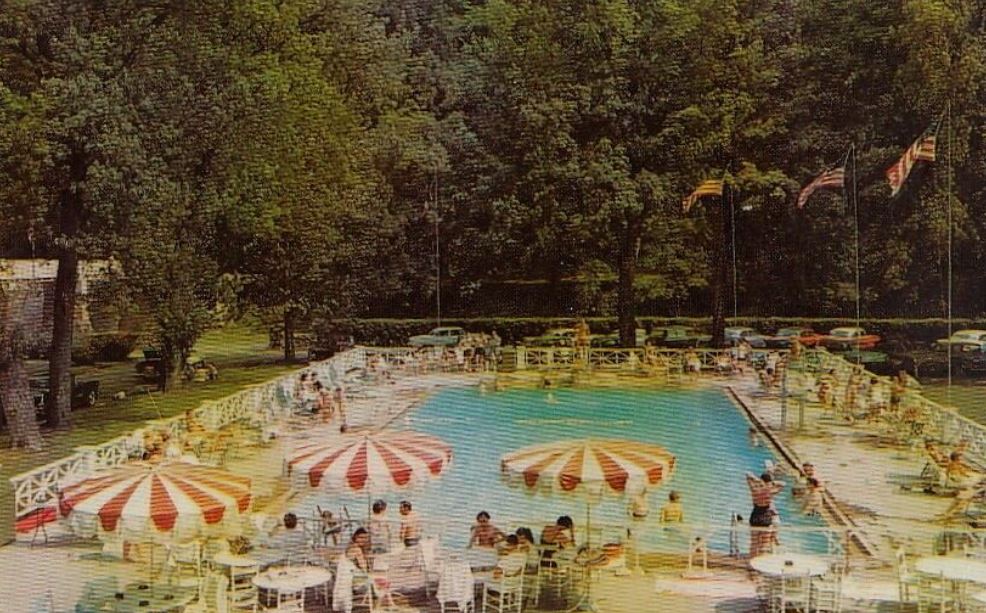
There are several other structures that constitute the Omni Bedford Springs Resort, though. The final lodging building constructed at the Omni Bedford Springs Resort is the six-story Barclay House, which appeared on the grounds in 1924. The building’s development came at a time when the resort was experiencing a bump in its business, due to the creation of the “Bedford Cure.” A three-week-long holistic therapy that used a combination of dieting, exercise, and local mineral water, the Bedford Cure was immensely popular throughout the Roaring Twenties. Architects designed the Barclay House with Greek Revival-style architecture and used brick to construct its exterior. The grounds also featured a variety of Colonial Revival-style buildings, the most notable of which were the Dormitory Building and the Pool Building. Both structures appeared on the grounds around the turn of the century, just as the Colonial Building was undergoing its first serious renovation.
Famous Historic Events
Summer White House (1857 – 1861): One of the most defining historical characteristics of the Omni Bedford Springs Resort is that it was an important political gathering place throughout the 19th century. Its proximity to Washington made it an incredibly accessible refuge for those seeking respite from the political activity of the nation’s capital. Many prominent congressmen and judges often frequented the location, including the renowned statesmen Henry Clay and John C. Calhoun. Yet, U.S. presidents were particularly fond of the Omni Bedford Springs Resort. Starting with Thomas Jefferson in 1819, nearly a dozen presidents used the resort as a place of rest and relaxation over the course of the 1800s. Pennsylvania’s own James Buchanan was the president who spent the most time at the Omni Bedford Springs Resort. Referring to it as his “Summer White House,” Buchanan spent the warmer months of his single term in office inside the resort. President Buchanan often hosted all sorts of Northern and Southern political figures within the facility as part of his desperate bid to forestall the outbreak of a civil war over slavery. He also entertained the Nicaraguan minister to the United States and presided over the passage of the Lecompton Constitution in 1857. Yet, the most notable event to transpire during his time at the resort was his reception of the first ever transatlantic telegraph in history. Sent from Queen Victoria of the United Kingdom, the message paid homage to the special friendship shared between Great Britain and the United States. Buchanan, in turn, replied to her note, completing the experiment.
Famous Historic Guests
- Thaddeus Stevens, noted abolitionist and Chairman of the U.S. House Ways and Means Committee (1861 – 1865)
- Simon Cameron, U.S. Secretary of War (1861 – 1862) and U.S. Senator from Pennsylvania (1867 – 1877)
- Henry Clay, U.S. Senator from Kentucky (1806 – 1807; 1810 – 1811; 1831 – 1842; 1849 – 1852) known for his roles in the Missouri Compromise and the Compromise of 1850.
- John C. Calhoun, U.S. Senator from South Carolina (1844 – 1843; 1845 – 1850) known for his role in the Nullification Crisis.
- Philander C. Knox, 40th U.S. Secretary of State (1909 – 1913) and U.S. Senator from Pennsylvania (1917 – 1921)
- Thomas Jefferson, 3rd President of the United States (1801 – 1809)
- Andrew Jackson, 7th President of the United States (1829 – 1837)
- William Henry Harrison, 9th President of the United States (1841)
- John Tyler, 10th President of the United States (1841 – 1845)
- James K. Polk, 11th President of the United States (1845 – 1849)
- Zachary Taylor, 12th President of the United States (1849 – 1850)
- James Buchanan, 15th President of the United States (1857 – 1861)
- James A. Garfield, 20th President of the United States (1881)
- William Howard Taft, 27th President of the United States (1909 – 1913) and 10th Chief Justice of the United States (1921 – 1930)
- Dwight D. Eisenhower, 34th President of the United States (1953 – 1961), and Supreme Allied Commander Europe during World War II
- Ronald Reagan, 40th President of the United States (1981 – 1989)
- George H.W. Bush, 41st President of the United States (1989 – 1993)
Guest Historian Series
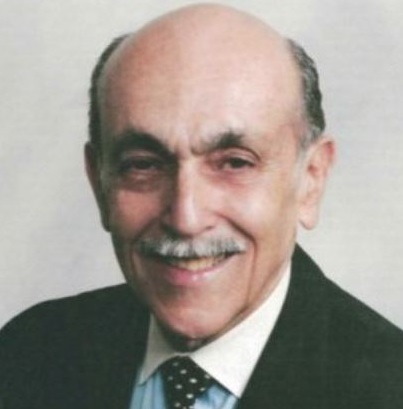
Hotel History: Omni Bedford Springs Resort (1806), Bedford, Pennsylvania*
Few properties can boast the historic significance of Bedford Springs Resort, located in the Allegheny Mountains of south-central Pennsylvania. For more than 200 years, the eight mineral springs located on the resort’s grounds served as an important gathering place. Eventually, the resort would be the site of many significant moments in American history, hosting a long list of celebrities, wealthy clientele, corporate magnates and dignitaries from around the world. To date, the resort has hosted 10 U.S. Presidents, seven of whom visited during their presidency.
The Native Americans first used the mineral springs for their curative properties, and in the late 1700s they shared the powers of the springs with a doctor named John Anderson. In 1796, Dr. Anderson purchased the 2,200-acres upon which the resort now stands. He built a home on the land and as word spread of these unique waters, visitors arrived from around the globe to experience them. He housed the guests in tents and offered custom prescriptions based upon their needs. Dr. Anderson and Dr. William Watson prescribed a regimen of diet, exercise and many pints of the spring water.
CONTINUE READING