
History
Discover The Omni Homestead Resort, which has offered guests, including U.S. President Thomas Jefferson, access to healing hot springs since 1832.
A National Historic Landmark, The Omni Homestead Resort has been a celebrated holiday destination for generations. The history of this fantastic vacation getaway dates all the way back to America’s colonial age. In 1764, he had acquired a land grant of some 300 acres in Virginia’s Shenandoah Valley for his service to the British Crown in the French and Indian War. This location featured close to a dozen mineral springs that had long carried a reputation for their alleged medicinal properties. Bullitt and two of his associates—Charles and Andrew Lewis—moved their entire militia company to the area shortly thereafter, who subsequently settled the land over the course of two years. During this time, Bullitt and his compatriots raised a rustic log hotel near a few of the mineral springs in the hope that it would attract travelers and their business. The captain and his family went on to operate the hotel for the next several decades, even after the Bullitt’s death during the American Revolutionary War. Over time, the Bullitt family hotel and its mineral springs built a reputation as a luxurious secluded retreat. Many prominent Americans visited in order to experience both a physical and spiritual rejuvenation. The most significant of these guests included Thomas Jefferson, who stayed at the hotel in 1818. The former president had become plagued by rheumatoid arthritis by that point in his life, and eagerly sought out the soothing mineral springs of the Bullitt family hotel. The trip proved to be so uplifting that Jefferson praised the entire location as being one the best places to vacation in the whole country.
But in 1832, a prominent physician named Thomas Goode purchased the hotel from the Bullitts. Taking heed of the mineral springs’ great medical qualities, he quickly introduced a system of European spa therapies that maximized their healing potential. One of the most famous treatments—known as “The Cure”—involved a salt scrub that was immediately followed by a relaxing Swiss shower. This fantastic service is still offered today. Dr. Goode passed away in 1858 and upon his death, the family managed the hotel for the next 30 years. They then sold the location to M.E. Ingalls, a notable lawyer from Cincinnati who had originally travelled to the area to survey it on behalf of the Chesapeake and Ohio Railroad. Ingalls had acquired the necessary capital to complete the sale by gradually partnering with a group of likeminded investors. Among the most active of these entrepreneurs was the legendary financier, John P. Morgan. Ingalls, Morgan, and the other investors then raised an additional $1 million to redevelop the building into a spectacular resort. Their plan encountered a temporary setback though, when a accident affected much of the site in 1901. Only a handful of the buildings that they had created managed to survive fully intact, such as the spa, casino, and a couple of cottages. Undeterred, the men decided to push forward with their dreams. Within a year, the resort’s Main Building—also known as the “Great Hall”—once again dominated the local landscape. M.E. Ingalls and the rest of his family managed to buy out the other stakeholders by 1911, becoming the sole owners of the resort.
The Ingalls then continued to expand upon the location, constructing a series of massive wings and event halls throughout the 1910s and 1920s. But their greatest contribution to the resort was the development of The Tower in 1929. This beautiful new addition quickly became the resort’s most iconic feature. Designed by architect Charles D. Wetmore of the renowned architectural firm Warren and Wetmore, The Tower displayed a wonderful blend of Colonial Revival-style architecture. The massive building cost the Ingalls family some $1 million to construct. Other magnificent facilities followed soon afterward, as well, including the development of a large ski area that is currently the most historic of its kind in all of Virginia. The resort only continued to grow in popularity under the Ingalls watch, as many prominent American luminaries vacationed there often. Sightings of U.S. presidents became common, too, with the likes of Franklin Delano Roosevelt, Dwight D. Eisenhower, John F. Kennedy, and Ronald Reagan stopping by every so often. Known today as “The Omni Homestead Resort,” the destination has been a part of Omni Hotels and Resorts since 2013. This wonderful historic getaway continues to be among the nation’s most prolific resorts, attracting dignitaries and celebrities from around the world. In fact, Omni Homestead Resort achieved an accolade unheard of for any hotel, inn, or resort located in the United States—celebrating its 250th anniversary back in 2016! Historic Hotels of America is proud to count the resort as one of its charter members.
Hotel Timeline
The Location
The Omni Homestead Resort is located in Bath County, Virginia, which is surrounded by a series of mineral springs that people have visited for centuries. The first tales of these elegant water sources date to ancient Native Americans, who relied upon the springs for their medicinal properties. Archeologists have even discovered evidence that the area’s indigenous peoples had used the mineral springs for more than 9,000 years. European Americans began using the mineral springs during the mid-18th century, with one of the first being Captain Thomas Bullitt. He wound up constructing a bathhouse at one location known as The Gentlemen’s Pool House that would work alongside its rustic hotel. The Gentlemen's Pool House was used by ladies and gentlemen alike, though at alternate times during the early morning and late evenings. In 1836, the circular Ladies' pool was constructed to give the women guests a pool of their own. President Thomas Jefferson, who suffered from rheumatism, visited these very pools in August of 1818. Omni Homestead Resort archives contain the original guest books documenting Jefferson’s 22-day visit, during which he found great relief in the warm mineral spring waters. The Gentlemen’s Pool House itself is similarly octagonal and about 120 feet in circumference. It holds about 43,000 gallons of constantly flowing spring water. During his visit, on August 13, 1818, Jefferson enjoyed breakfast at The Homestead, soaked in the springs, and had his dinner. He recorded that the entire day’s activities cost him $2.12 and wrote to one of his daughters praising the springs as among the best in America. That is why the pool houses are named in his honor today. The United States Geological Survey determined that these springs have a remarkably uniform rate of temperature and flow and are unaffected by changes of the seasons – their waters are natural body temperature all year and flow at the astounding rate of 1,700,000 gallons per day. The mineral content of the water is so high that people float effortlessly.
The Architecture
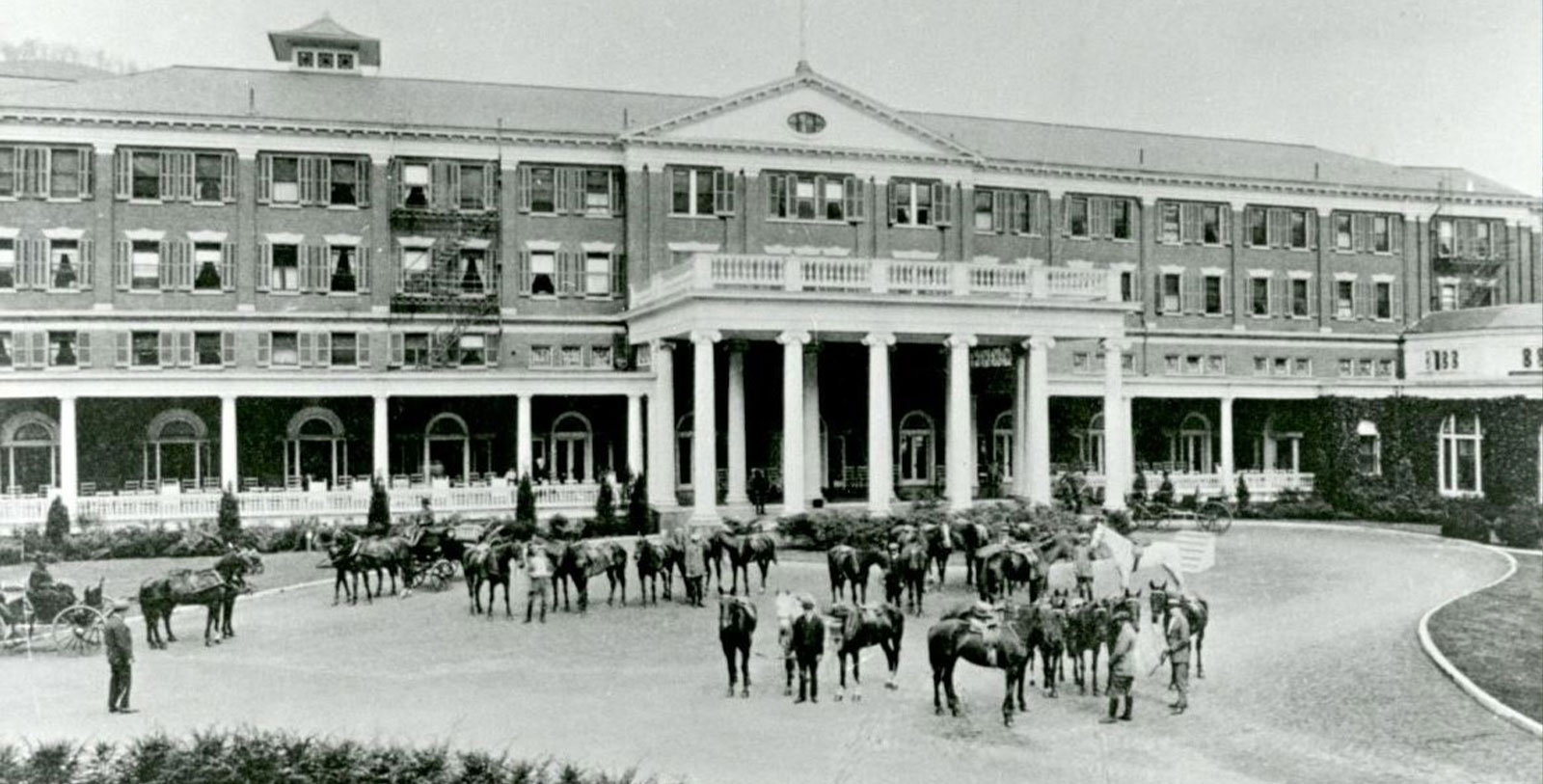
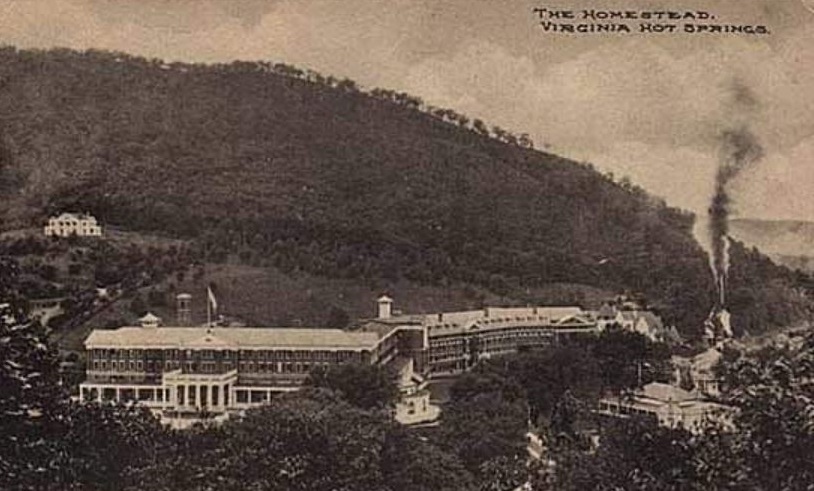
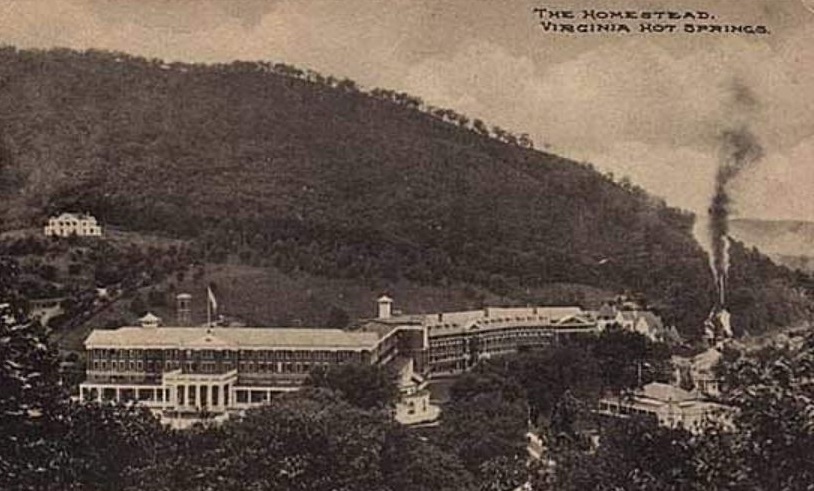
The current iteration of The Omni Homestead Resort harkens back to 1902, when E.M. Ingalls and his business partners redeveloped the grounds into a leading holiday destination. The architectural firm Elzner and Anderson designed the original structure to the resort’s Main Building, using Georgian Revival-style architecture to structure its appearance. It possessed many iconic characteristics of Georgian Revival design aesthetics, as such, including a symmetrical façade characterized by a hipped roof and a central projecting pavilion. Modillion cornices and massive brick pilasters proliferated across its exterior, as did a prominent stone belt course. The most defining feature of the structure involved its Ionic portico that housed the three main entrances. Elzner and Anderson quickly expanded upon their work a year later when they developed an adjoining West Wing, which stood nearly five stories tall. The firm would return one more time to The Homestead in 1914 to construct a third series of accommodations at the East Wing. But unlike their first creation, the West and East wings display a composition of Colonial Revival architecture.
The resort’s proprietors—the Ingalls family—continued to add onto the main building throughout the 1920s, installing a series of luxurious facilities like the Garden Room, Crystal Room, and Empire Room. But the greatest of these structures to emerge around this time was a magnificent, ten-and-a-half-story edifice known affectionately as “The Tower.” Costing close to $1 million to complete, it quickly became the resort’s most iconic structure. Architect Charles D. Wetmore of the renowned architectural firm Warren and Wetmore led the design team. Constructing The Tower in between the Main Building and the East Wing, Wetmore followed in the footsteps of Elzner and Anderson and used Colonial Revival-style architecture of the exterior. The first seven stories of the building featured a beautiful series of recessed porches, as well as a tall casement windows bordered by Doric columns. A seven-sided pavilion also juts out from the southern portion of the façade, which housed the tower lounge. The remaining stories displayed a hipped standing seam-metal roof surmounted by a exquisitely detailed clock tower and cupola. Two five-story brick wings flanked The Tower as well, designed to suggest that it was constructed at the same time as the Main Building below.
Yet, there are some structures that predate Omni Homestead Resort’s Main Building by close to a decade. The greatest of these buildings is the Homestead Bathhouse, which survived the destructive kitchen fire that destroyed most of the resort’s original facilities. Designed by the firm Yarnell and Goforth, the bathhouse first appeared on the grounds in 1892. It, too, displayed a beautiful blend of Colonial Revival architecture, although its exterior has undergone extensive alterations since then. The Homestead Bathhouse stood two-and-a-half stories that extended along a rectangular layout. Brick served as the primary building material for the exterior, which featured an exquisite six-bay Corinthian portico and modillion cornices. Arched Palladian windows spread across the first floor, while paired and tripled round-arched windows appeared on the second. Other historic structures that date back to the Homestead Bathhouse are the Casino—a one-story, hip-roofed pavilion—the Virginia Hotel, and several rustic cottages that line the periphery of the location.
Famous Historic Events
Founding of the United Nations’ Food and Agriculture Organization (1943): At the height of the Second World War, President Franklin Delano Roosevelt called for an international gathering to discuss the security of the international food supply once the conflict had ended. Attempts to somehow coordinate the availability of food throughout the world dated back to the start of the 20th century, when King Victor Emmanuel III of Italy established the International Institute of Agriculture in 1905. Yet, its purpose was limited in scope as it worked to primarily distribute data on global agriculture. The outbreak of World War II effectively dismantled the International Institute of Agriculture. In its wake, Roosevelt sought to establish a stronger body that operated as a part of the emerging United Nations, with the hope that it could work more directly in combating widespread hunger. To address the problem, Roosevelt organized a summit called the United Nations Conference on Food and Agriculture in 1943. Hosted at The Homestead between May 18 and June 3, representatives from 44 different nations wound up attending the event. The discussions held among the conference participants eventually gave rise to the Food and Agriculture Organization, which formally came into existence two years later in Québec City. The entity quickly became a central pillar for the nascent United Nations, providing a source of agricultural support to the world’s many developing countries. The Food and Agriculture Organization still endeavors today in its goal to eliminate international malnutrition from the planet.
Famous Historic Guests
- John P. Morgan, legendary financier and founder of J.P. Morgan and Co.
- Henry Ford, celebrated industrial responsible for founding the Ford Motor Company.
- John D. Rockefeller, renowned industrial magnate who founded the Standard Oil Company.
- Edith Wilson, First Lady of the United States (1915 – 1921)
- Edward VIII, King of the United Kingdom and later Duke of Windsor following his abdication in 1936.
- Jacqueline Kennedy Onassis, First Lady of the United States (1961 – 1963)
- Thomas Jefferson, 3rd President of the United States (1801 – 1809)
- James Madison, 4th President of the United States (1809 – 1817)
- William McKinley, 25th President of the United States (1897 – 1901)
- Theodore Roosevelt, 26th President of the United States (1901 – 1909)
- William Howard Taft, 27th President of the United States (1909 – 1913) and 10th Chief Justice of the United States (1921 – 1930)
- Woodrow Wilson, 28th President of the United States (1913 – 1921)
- Warren G. Harding, 29th President of the United States (1921 – 1923)
- Calvin Coolidge, 30th President of the United States (1923 – 1929)
- Herbert Hoover, 31st President of the United States (1929 – 1933)
- Franklin Delano Roosevelt, 32nd President of the United States (1933 – 1945)
- Harry S. Truman, 33rd President of the United States (1945 – 1953)
- Dwight D. Eisenhower, 34th President of the United States (1953 – 1961) and Supreme Allied Commander Europe during World War II
- John F. Kennedy, 35th President of the United States (1961 – 1963)
- Lyndon B. Johnson, 36th President of the United States (1963 – 1969)
- Richard Nixon, 37th President of the United States (1969 – 1974)
- Gerald Ford, 38th President of the United States (1974 – 1977)
- Jimmy Carter, 39th President of the United States (1977 – 1981)
- Ronald Reagan, 40th President of the United States (1981 – 1989)
- George H.W. Bush, 41st President of the United States (1989 – 1993)
- Bill Clinton, 42nd President of the United States (1993 – 2001)
- George W. Bush, 43rd President of the United States (2001 – 2009)
Guest Historian Series
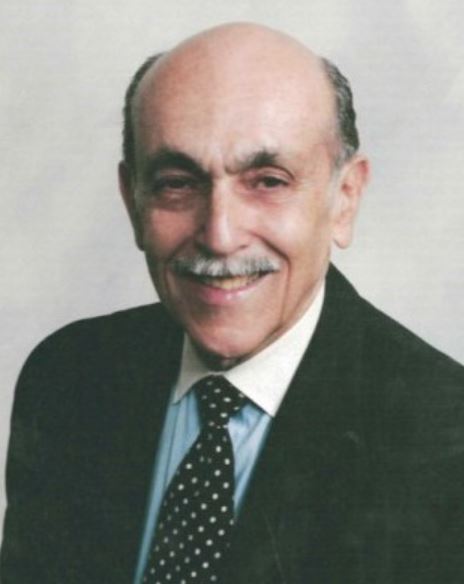
The Homestead is a famous luxury resort that opened a decade before the American revolutionary war. Located in the middle of the Allegheny Mountains, the area has the largest hot springs in Virginia. Native Americans used the waters to rejuvenate themselves during their many excursions through the area.
Captain Thomas Bullett and Charles and Andrew Lewis were part of the militia and surveyors during the French and Indian War. They were told of the many healing qualities of the waters in the area. In 1764, at the end of the war, Bullett received Gold and Silver medals for his services and was awarded a colonial land grant of 300 acres.
Continue Reading