
Golf
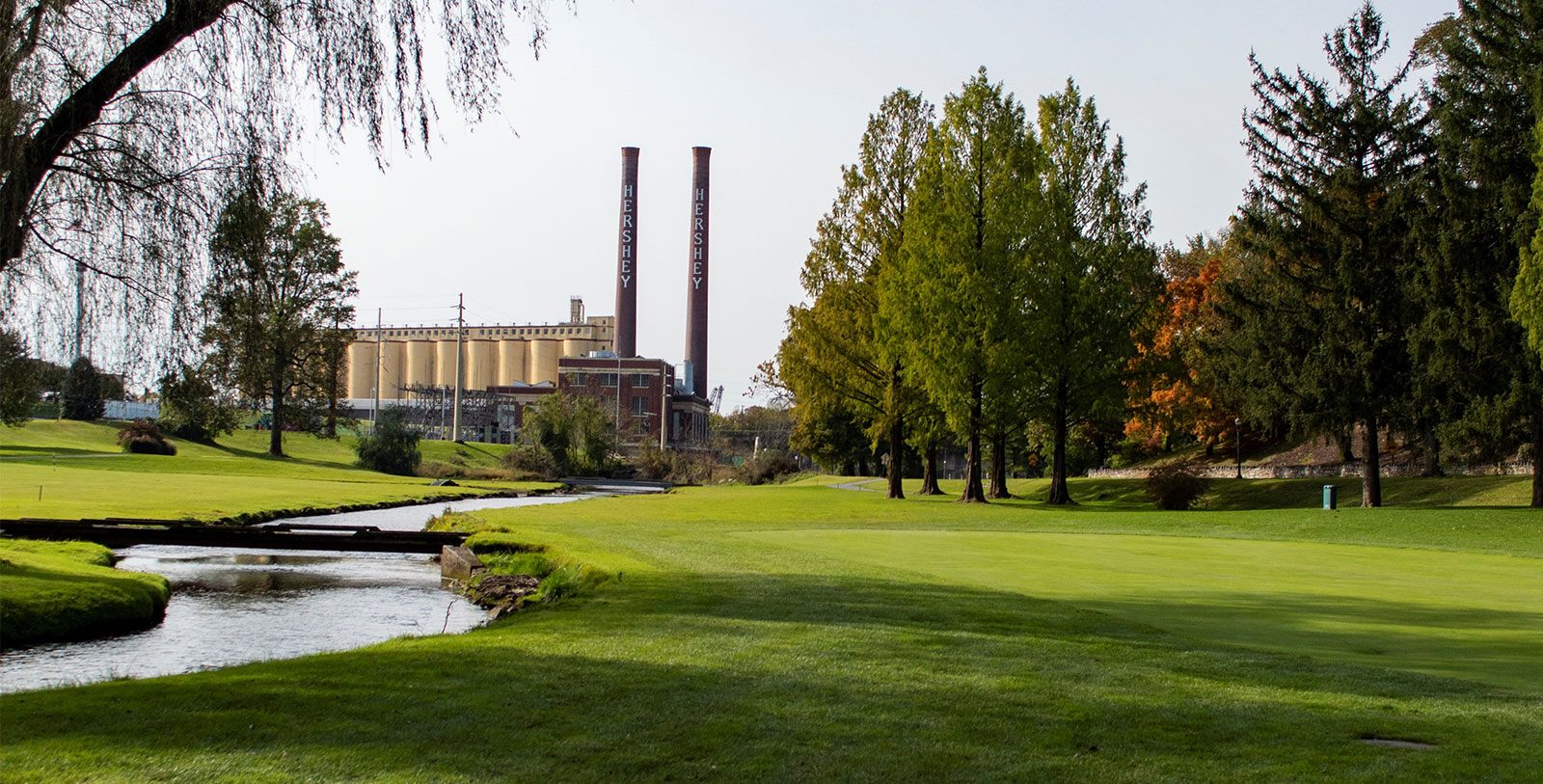
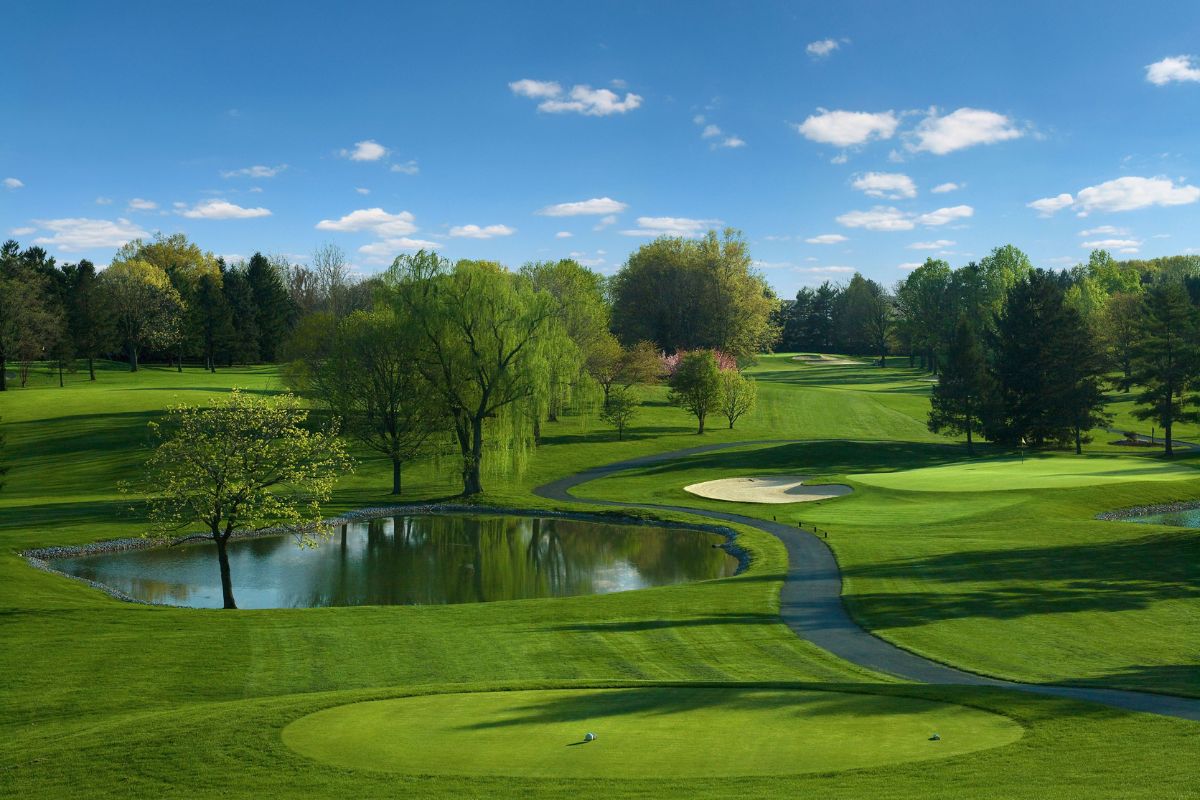
Discover the fantastic golf courses at the Hershey Country Club: the East, West, and Spring Creek Courses.
The Hotel Hershey offers its guests access to the historic Hershey Country Club. Known for its historic championship courses and signature services, the facility is the perfect destination for a memorable golf getaway. Golf has been a fixture of Hershey since 1909—before the Hershey Country Club was ever founded, there was the “Hershey Golf Club.” A rustic nine-hole course, the club was specifically placed between the chocolate factory and Milton S. Hershey’s home, High Point. But the chocolate magnate had bigger plans for the game in “The Sweetest Place on Earth” and opened the Hershey Country Club in 1930. The only course available was the par-73 West Course at the time, with High Point doubling as its clubhouse. Maurice McCarthy oversaw its development, who had previously designed several other courses throughout the United States during the 1920s. Its popularity surged upon its triumphant debut, despite economic turmoil that had started to impact the nation. Indeed, countless golfers traveled from afar to try its spectacular fairways and greens, truly making it one of the best places for golf in the country. Then nearly 40 years later, the par-71 East Course was constructed by George Fazio as a means of accommodating the sheer volume of visiting golfers. (He and his nephew, fellow golf professional Tom Fazio, would then design Pinehurst No. 6 in Pinehurst, North Carolina, not long thereafter.) Today, the East and West Courses continue to be ranked as among the most elite locations for a round of golf. The Hershey Country Club has even received numerous accolades for its fantastic amenities and gorgeous course layout, including the Distinguished Club award from BoardRoom magazine.
Many historic golfers have been seen walking the greens, such as Gene Sarazen, Walter Hagen, and Arnold Palmer. A few have even worked for the Hershey Country Club over the years, as well. In 1934, for instance, Henry Picard was hired as head professional and served until the outbreak of World War II. Nicknamed the "Hershey Hurricane" and “Chocolate Soldier,” his on-course skills led to 26 wins on the PGA Tour. Among his most memorable accomplishments were the 1936-1937 Hershey Open, 1938 Masters Tournament, and the 1939 PGA Championship. After Picard, legendary professional golfer Ben Hogan—considered one of the greatest players of all time—operated as the head professional starting in 1941. Of his 63 tournament wins, 52 occurred during his tenure as Hershey’s golf professional, including six majors. Several national tournaments have been held at the Hershey Country Club since its founding amid the Great Depression, too. The West Course hosted its own event, the Hershey Open, periodically throughout the 1930s. In 1940, the West Course the hosted the 23rd PGA Championship, where Byron Nelson beat Sam Snead during one of his 11-straight PGA Tour victories. The course later the site of the Ladies’ PGA Lady Keystone Open between 1978 and 1994. The East Course itself hosted the Reese's Cup Classic for years until 2004. More recently, it has been the location of the 44th PGA Professional National Championship, the 51st USGA Women’s Senior Amateur Championship, and the NCAA Division II Men's Golf National Championship (in 2013).
Nearby, the club offers an 18-hole putting course at The Hotel Hershey, as well as access to the Spring Creek Golf Course. Like the neighboring West Course, the Spring Creek Golf Course was crafted by Maurice McCarthy during the 1930s. A nine-hole course, McCarthy specifically crafted its fairways with junior players in mind. In fact, it was the nation's first public golf course created for players aged 18 and younger. Originally called the “Juvenile Golf Club,” the course allowed adolescent players to golf for a fee of 35 cents when it first opened. It subsequently became one of the area’s most popular attractions, entertaining hundreds of aspiring youth golfers for generations. In 1969, the name was changed to highlight Spring Creek amid greater renovations transpiring throughout the course. The moniker drew its inspiration from the famous water hazard that wound across the course’s landscape. Award-winning 21st-century golf course architect Tom Clark oversaw another round of course renovations in 2001, which thoroughly revitalized the facility’s architectural integrity. Among the work that Clark accomplished involved three new hole designs, restoration of six existing holes, and the installation of 220 additional playing yards. His construction efforts even established a brand-new tee-through-green irrigation system, as well as an overhaul to its preexisting turf grass. The Spring Creek Golf Course has thus remained one of America’s best places for young golfers to hone their skills.
Golf Timeline
The Location
The current town of Hershey, Pennsylvania, can trace its roots all the way back to legendary chocolate manufacturer Milton S. Hershey. Born on a rustic farm in the village of Derry Church, Hershey had long dreamed of starting his own candy empire. He apprenticed in the candy-making industry during his youth, before founding several businesses on his own in Philadelphia, New York, and Chicago. Eventually in 1883, Hershey established the successful Lancaster Caramel Company in Lancaster, Pennsylvania, which gave him a real toehold in the industry. Over time, Hershey became deeply fascinated with the chocolate manufacturing processes of German candy chefs after viewing their technology at the World’s Columbian Exposition of 1893. Inspired, he immediately sold his caramel company for $1 million, using the finances to build an imposing facility in his home of Derry Church. German and other Central European candy makers were long considered to be the best in the field, with their milk chocolate treated as an expensive luxury. Hershey, as such, hoped to patent an inexpensive way to replicate their methodology. Fortunately, Hershey managed to invent a cheap, innovative process to recreate the recipe for mass consumption. He subsequently sold his caramel company for $1 million and used those finances to start constructing a massive plant in Derry Church.
Ground on the project broke in 1903 and took nearly two years to complete. Debuting as the main facility for the newly created “The Hershey Company,” the plant spanned for some 65 acres! Hershey had selected his hometown as the site for his humungous factory due to its proximity to countless dairy farmers. Furthermore, Derry Church had direct access to the Philadelphia and Reading Railroad, as well as a major thoroughfare called the “Berks and Dauphin Turnpike.” But Hershey had much larger plans for Derry Church than merely opening a factory. He intended to transform the entire town itself! Through the construction of brand-new residential dwellings and civic structures, Hershey hoped that the reborn Derry Church would serve as the perfect company town for his employees. Hershey started drawing blueprints for a 150-acre town grid that would be anchored by his sprawling plant. He then organized the Hershey Improvement Company—a subsidiary of The Hershey Company—to oversee the implementation of his grand plan. The Hershey Improvement Company used a portion of its parent company’s finances to start raising houses and several municipal buildings. Hershey also commissioned Harry Neff Herr to serve as the town’s first civil engineer, who quickly developed a civic transportation system, namely its popular trolley car railway. By the end of the decade, the town had an actual rail depot, phone service, and a gorgeous public square!
Now known as “Hershey,” the town soon started to change into a prominent holiday destination following Hershey’s creation of an amusement park nearby. Opened in 1906, it originally featured a series of carnival games, a rustic bandstand, and a pavilion that hosted live theatrical performances. At first, the amusement park was meant to treat the employees of the factory. But when word spread of the attraction’s appeal, guests from across the Northeast arrived in great numbers. Realizing yet another lucrative financial opportunity, Hershey soon advertised the location as a destination that American families could enjoy for a brief vacation. He also started installing newer facilities throughout the grounds, too, including a merry-go-round, an activity center, and a passenger railroad that ferried guests out to the surrounding countryside. In 1912, Hershey partnered with William H. Dentzel of Philadelphia to construct a $1,500 carousel that had 53 different animals. The Roaring Twenties saw even more structures developed onsite, the most notable of which was a towering roller coaster known as “The Wild Cat.” By the end of World War II, there were more than two dozen different attractions within the amusement park, making it one of the largest compounds of its kind in the country. Called “Hersheypark,” it has since become one of America’s greatest cultural landmarks. While it features many modern rides and games, some of its attractions—including “The Comet,” which replaced “The Wild Cat” in 1946—are nearly as historic as the town of Hershey itself. Both Hershey and Hersheypark have continued to be one of America’s best holiday destinations ever since.
The Architect
Maurice McCarthy: When Milton S. Hershey opened the Hershey Country Club at the start of the Great Depression, he had relied heavily upon the input of golf pro Maurice McCarthy to craft its initial 18-hole course—the West Course. The West Course’s origins specifically harkened back a few years earlier to a rudimentary nine-hole course that Hershey himself had built in between his home, High Point, and the chocolate factory. But the plant’s continuous expansion soon encroached upon the golf course, gradually reducing its size down to just a couple of holes. In consequence, visiting guests were forced to play at neighboring courses in neighboring cities. Hershey subsequently made the decision to construct a second golf course during the 1920s, and began surveying new locations around Hershey, Pennsylvania. Recognizing the need for a full 18-hole golf course, Hershey eventually settled on a large plot of land at a place known locally as “Pat’s Hill.” While Hershey initially hired architect Harry N. Herr to craft the course, he nonetheless desired to obtain the opinion of other golf professionals. Hershey thus sought the counsel of Maurice McCarthy, a Scottish golfer who had become somewhat well-known on the American professional golf circuit. Assessing the plans, McCarthy determined that the blueprints were ill-suited to create a grand golf course. Convinced by McCarthy’s assessment, Hershey quickly commissioned him to take over the entire project. Even though the construction took months to complete, McCarthy still managed to create a stunning collection of fairways that many found deeply enthralling. Among the impressed was Milton S. Hershey, who rehired McCarthy to create yet another facility in Hershey. This time, though, Hershey asked McCarthy to develop a unique course meant only for minors—the Juvenile Golf Club. Finished in 1932, the area operates today as a public facility called the “Spring Creek Golf Course.”
George Fazio: The architect behind the Hershey Country Club’s East Course, George Fazio had actually spent much of his career as a professional player. Originally a native of Philadelphia, Fazio was one of eight children born to Italian immigrant parents. Like many of his contemporaries, he began playing golf at a young age. Indeed, Fazio first caddied golf when he was just nine years old! But his work as a caddie also enabled Fazio to practice golf regularly, which he picked up rather quickly. He eventually began competing professionally at various tournaments around Philadelphia and even secured a spot as the head professional for the Pine Valley Golf Club. In fact, Fazio’s success on the professional circuit made him a respected name in golf by the end of World War II! Fazio even won two PGA Tour-sponsored events—the 1946 Canadian Open and the 1947 Bing Crosby Pro-Am. He also competed seven different times at the Masters Tournament, although he only finished in the top-15 once—in 1952. Perhaps his most memorable moment occurred when he placed third at the 1950 U.S. Open behind Llyod Mangrum and Ben Hogan. Nevertheless, his playing career came to an end during the mid-1950s. In its wake, Fazio picked up another profession—golf course design. In 1955, he was specifically tasked to renovate Cobbs Creek Golf Club in time for that year’s PGA Tour stop. Fazio’s work was well-received, which enabled him to obtain many other leads for more projects. Impressively, Fazio would design a total of 64 courses over the next several decades, working on such renowned courses as the Jupiter Hills Club, Butler National Golf Club, and Hershey Country Club’s East Course. Fazio completed much of his designs with his nephew, Tom Fazio, who played an instrumental role on his team. Among George and Tom’s greatest work together involved their creation of Pinehurst No. 6, which is regarded today as one of America’s most celebrated courses.
Famous Historic Tournaments
23rd PGA Championship (1940): While not as famous as his 11 consecutive tournaments victories in 1945, Byron Nelson’s triumph at the 23rd PGA Championship was still a watershed moment in his legendary career. Nelson was already among the sport’s rising stars by the eve of World War II, having finished first at the 4th Masters Tournament and the 43rd U.S. Open during the late 1930s. In fact, Byron had even shot a 66 while competing at the Masters Tournament—a record that would remain in place for four decades until Raymond Floyd passed it in 1976. Byron subsequently entered the PGA Championship in 1940, joining a talented group of competitors that included Denny Shute, Gene Sarazen, and Henry Picard—the defending champion. (Walter Hagen was also a contestant, although he was entering the twilight of his career at the time.) Nelson managed to stay ahead of his competitors, completing the 36-hole stroke-play qualifier required to enter the tournament’s championship round. Despite heavy rains momentarily interrupting the finals, Nelson nonetheless maintained his composure. Indeed, he succeeded in defeating Eddie Kirk and Ralph Guldahl in very close matches during the quarterfinals and semifinals. The last round of the PGA Championship commenced on Labor Day, which saw Nelson square off against the equally talented Sam Snead. The bout proved to be incredibly tight, with Nelson barely beating Snead one up on the final green of the 36-hole match. The victory became Nelson’s third major championship title of the five he won over the span of his brief career—he would later finish first at the 9th Masters Tournament and the 27th PGA Championship, too. (Nelson—who retired in 1946—also obtained a total of 52 titles on the PGA Tour, ranking him sixth overall.)
Famous Historic Golfers
- Byron Nelson, winner of five major golf championships that include the Masters Tournament, the PGA Championship, and the U.S. Open.
- Sam Snead, winner of seven major golf championships that include the PGA of America and Senior PGA Tour.
- Gene Sarazen, winner of seven major golf championships that include the U.S. Open, the British Open, the PGA Championship, and the Masters Tournament.
- Walter Hagen, winner of 11 major golf championships, including the U.S. Open, the British Open, and the PGA Championship.
- Denny Shute, winner of three major golf championships that include the British Open and PGA Championship.
- Arnold Palmer, winner of seven major golf championships that include the PGA Championship and the Masters Tournament.
- Jan Stephenson, winner of three major LPGA championships, including Women’s PGA Championship, the U.S. Women’s Open, and the du Maurier Classic.
- Susie Maxwell Berning, winner of four major LPGA championships, including the Wester Open and U.S. Women’s Open.
- Julie Inkster, winner of seven major LPGA championships, including the U.S. Women’s Open, the Women’s PGA Championship, the ANA Inspiration, and the du Maurier Classic.
- JoAnne Carner, the only woman to have won the U.S. Girls' Junior, U.S. Women's Amateur, and U.S. Women's Open.
- Amy Alcott, winner of five major LPGA championships, including the U.S. Women’s Open, the ANA Inspiration, and the du Maurier Classic.
- Tom Ridge, 43rd Governor of Pennsylvania (1995 – 2001)
Women in Golf
JoAnne Carner: Among the accomplished golfers to compete at the Hershey Country Club was JoAnne Carner. Originally a native of Kirkland, Washington, Carner had developed quite a reputation in her youth during the mid-20th century. In fact, one of her earliest achievements involved winning the U.S. Girls’ Junior title in 1956. Then, a few years later, Carner managed to earn a national collegiate title while playing for Arizona State University in the Association for Intercollegiate Athletics for Women championships. Meanwhile, Carner won five separate U.S. Women’s Amateur Titles and finished as the runner-up on two other occasions. The victories were an impressive record for Carner, as they placed her second on the all-time list of winners behind only the legendary Glenna Collett Vare. While still competing as an amateur in the late 1960s, Carner decided to enter an official LPGA Tour event—Burdine’s Invitational—and came in first place. The victory subsequently marked the beginning of a lucrative professional career that saw Carner win a total of 43 tournaments on the LPGA Tour. Her most iconic victories occurred as a contestant at the U.S. Women’s Open, which she won twice in 1971 and 1976. But Carner gained many other noteworthy achievements throughout her lifetime, too, including five Vare Trophies, three LPGA Tour Player of the Year awards, and the 1970 LPGA Tour Rookie of the Year. In 1981, she even received the Bob Jones Award—the highest honor given in recognition of a player’s sportsmanship by the USGA. A member of the World Golf Hall of Fame, Carner has since remained the only woman to have won the U.S. Girls’ Junior, the U.S. Women’s Amateur, and the U.S. Women’s Open.
Amy Alcott: One of the most elite female golfers to ever play at the Hershey Country Club was Amy Alcott. A member of the World Golf Hall of Fame, Alcott has been a celebrated name in professional golf since her debut on the LPGA Tour decades ago. She first began pursuing the game during her youth, putting balls into soup cans at the age of seven. As Alcott grew older, she began practicing her driving skills and finally entered the LGPA Tour in 1975. Alcott proved to be a natural, earning her first victory at her third-ever professional tournament—the Orange Blossom Classic. Her success eventually earned Alcott the title of LPGA Rookie of the Year. From there, Alcott went on to win more than 30 more tournaments throughout the span of her career. But her first major victory occurred as a competitor at the Peter Jackson Classic in 1979, known today as the “du Maurier Classic.” Shooting seven under par, she managed to defeat many other renowned golfers like Nancy Lopez. From there, Alcott succeeded in winning four other major championships over the next 11 years, including three different ANA Inspiration titles and a single U.S. Women’s Open. In honor of her five major championships, the World Golf Hall of Fame inducted Alcott as one of its members in 1999. Alcott stepped away from her playing career to follow other endeavors, with the most notable activity being golf course architecture. In fact, Alcott played an instrumental role in designing the golf course that would be used during the 2016 Summer Olympics in Rio de Janeiro!
Juli Inkster: Another accomplished golfer to grace the Hershey Country Club is World Golf Hall of Famer Juli Inkster. Inkster initially got her start in golf as an employee at the Pasatiempo Golf Club. Training regularly on its greens, she gradually developed an affinity for the sport. Inkster eventually played competitively while enrolled as a student at San Jose State University, becoming an All-American three out of the four years she attended college. Inkster also began to participate in various elite-level amateur competitions, starting with the California State Amateur Championship in 1981. She also was a member of the winning teams for the Curtis Cup and Espirito Santo Trophy contests around the same time, too. But perhaps the highlight of her career was the three consecutive U.S. Women’s Amateur titles that she won from 1980 to 1982. Inkster subsequently turned professional amid the LGPA Tour’s 1983 season and quickly won her first official tournament not long thereafter. The following year saw Inkster win two major competitions, as well—the du Maurier Classic and the ANA Inspiration. The victories were a foreshadowing of greater success, as Inkster would go on to win another five major championships during her career. Indeed, she specifically placed first at the ANA Inspiration again in 1989, and won two titles apiece at both the Women’s PGA Championship and U.S. Women’s Open. In fact, she was even among the select few to experience a career Grand Slam! In all, Inkster won an impressive 31 events on the LPGA Tour, ranking her highly among the greatest women to ever play golf. (Inkster also played on the United States’ Solheim Cup team nine different times. Her combined score of 18.5 points has since made her the most successful American to enter the tournament.)