
History
Discover the Jekyll Island Club Resort founded by the elites of American Gilded Age society and providing luxury for the discerning 21st century traveler.
Jekyll Island Club Resort is one of the few resorts in the United States that the U.S. Secretary of the Interior has designated a National Historic Landmark. Its history goes back to the beginnings of Gilded Age America, in which Newton Finney and his brother-in-law, John Eugene DuBignon, decided to create a seclusive hunting club for the era’s prosperous businessmen. The two men decided to establish the club on the DuBignon family estate on Jekyll Island, which John’s descendants had inhabited since the early 18th century. In order to finance the construction of the club’s main facilities, Finney pitched stock ownership in the new venture to prospective members. Some of the most influential Americans quickly became owners, including financier John P. Morgan, journalist Joseph Pulitzer, and department-store magnate Marshall Field. In all, Finney and DuBignon found 53 individuals to serve as co-owners of the new club. The group met in New York to discuss the various by-laws and fees that would come with being a member. They selected the renowned attorney Lloyd Aspinwall to serve as its first president, with Judge Henry Elias Howland as Vice President. After seven long years, the group finally founded their luxurious holiday destination as the “Jekyll Island Club” in 1886.
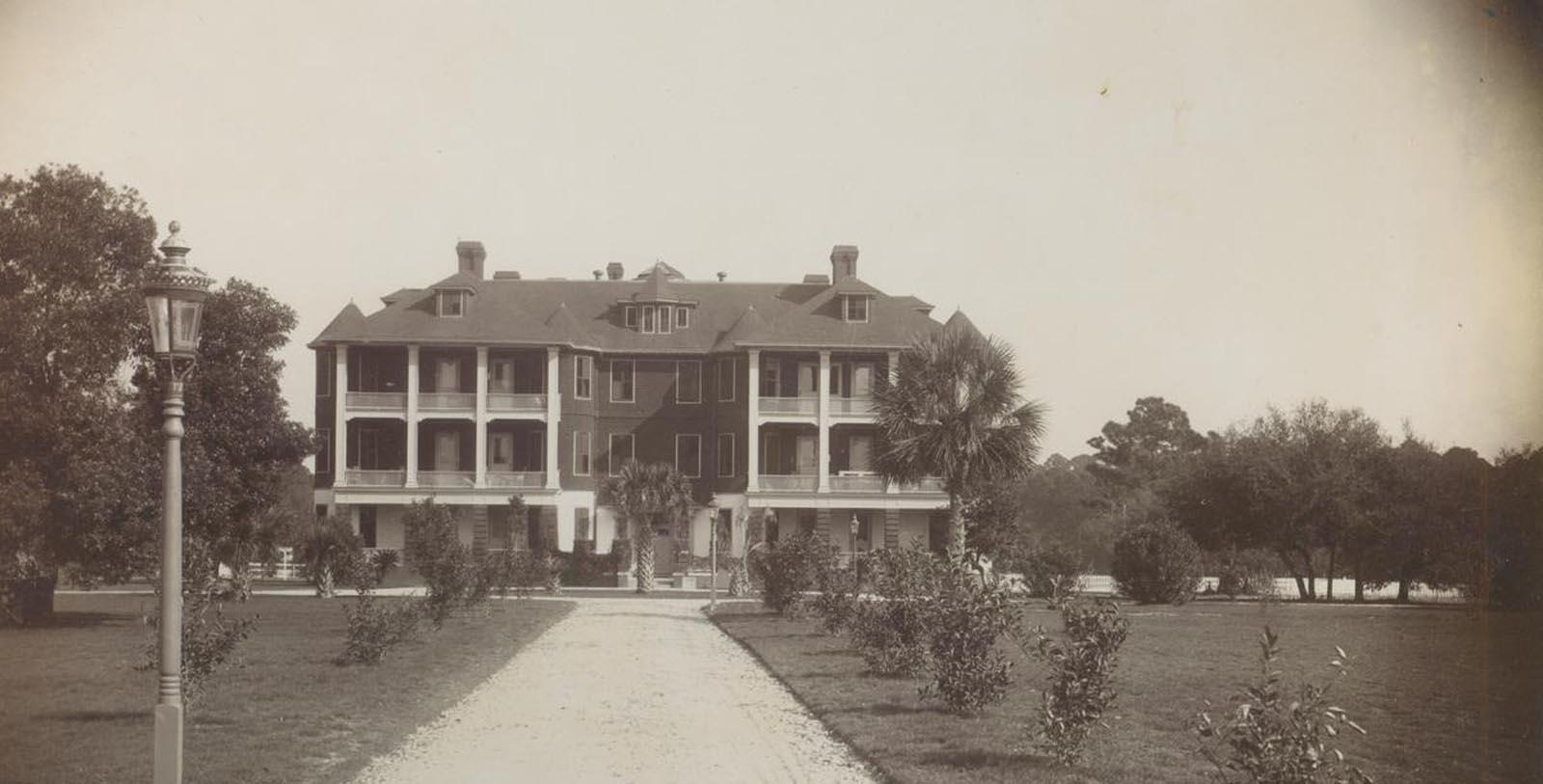
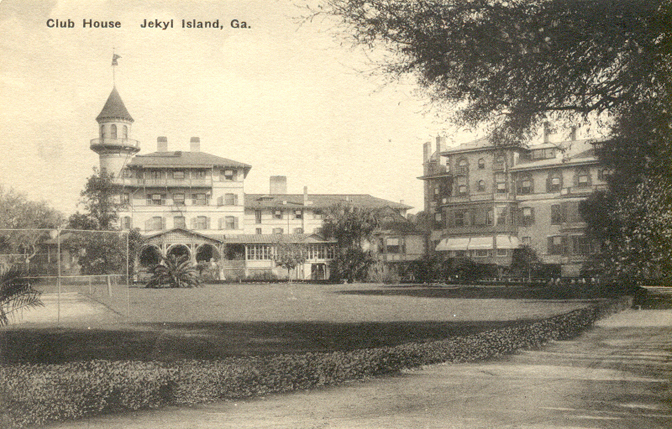
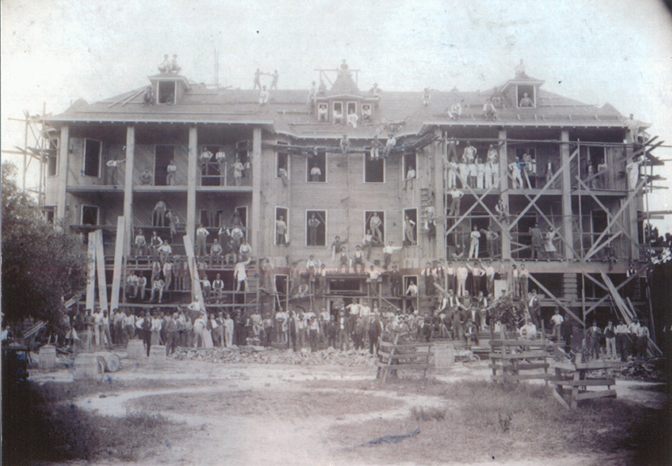
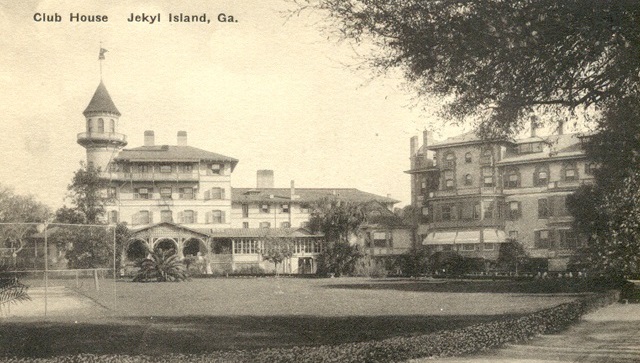
Construction on the facility began almost immediately with the development of the “Clubhouse.” Opening some two years after its grand debut, the Clubhouse would go on to become the main building for the Jekyll Island Club. Designed by renowned architect Charles A. Alexander, this magnificent building displayed a gorgeous blend of Queen Anne-style architecture. Several other beautiful buildings soon followed over the next several decades, such as the Faith Chapel, San Sourci, and the Morgan Tennis Court. The club’s most illustrious guests also developed their own summer retreats, which spread throughout the grounds. Eighteen in all, these spectacular seasonal cottages featured an amazing combination of architectural styles found across Europe. Famous landscape architect Walter J. Travis also designed the club’s renowned golf course, “Great Dunes.” Jekyll Island Club had started to develop a reputation as a golfer’s paradise, when the United States Golf Association chose it as the site for equipment testing. Travis died roughly a year into the project and did not get to see his grand idea come to fruition. Nevertheless, the fairways at the Great Dunes Golf Course became some of the most popular—and challenging—throughout the entire country.
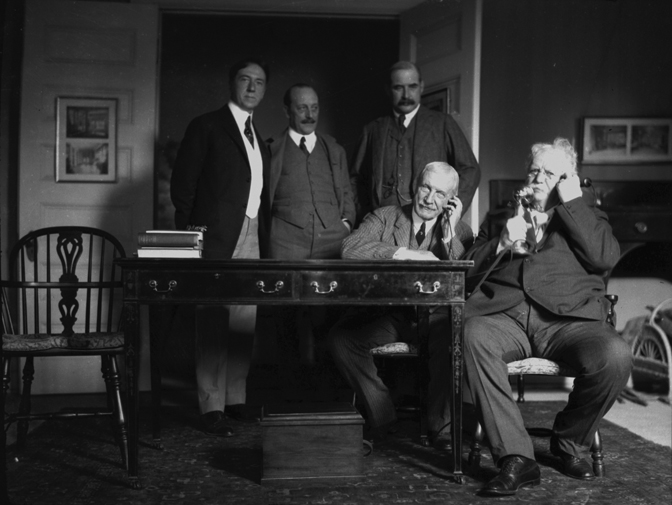
By the turn of the 20th century, Jekyll Island Club became the gathering spot for the nation’s leading figures. Its membership list featured the names of prominent American families, including the Rockefellers, the Vanderbilts, and the Goulds. William Rockefeller, a co-founder of Standard Oil, developed the first summer home onsite known as “Indian Mound.” A few others followed suit, including Richard T. Crane, Walter Jennings, and Frank Gould. Senator Nelson Aldrich of Rhode Island decided to host a top-secret meeting with American financial leaders at the club in the aftermath of the Panic of 1907. Together, their discussions led to the creation of the Federal Reserve in 1913. The President of the American Telephone and Telegraph, Theodore N. Vail, also conducted the first transcontinental telephone call from the Jekyll Island Club. Among the attendees to partake in the call remotely were Alexander Graham Bell and U.S. President Woodrow Wilson.
The prosperity of the Jekyll Island Club was not to last. When the Great Depression befell the country during the 1930s, the club struggled to retain membership. Its management team tried a variety of novel ideas that sought to attract more people. World War II proved to be the final straw though, as most of the male staff left the area to enlist in the U.S. military. As such, it became impossible to operate the Jekyll Island Club, and it shuttered its doors in 1942. The State of Georgia then came to its rescue several years later in 1947, when it purchased Jekyll Island—including the club—for sum of $675,000. Under the guidance of Revenue Commissioner Melvin E. Thompson, the state rehabilitated the Jekyll Island Club into a public resort. But it, too, struggled to make the endeavor profitable, closing the entire business down in 1971. Sitting dormant for more than a decade thereafter, the resort received a much-needed renovation when Leon N. Weiner & Associates acquired it in 1985. Now operating as the “Jekyll Island Club Resort,” this magnificent historic resort has since resumed its status as one of America’s best vacation getaways.
Hotel Timeline
The Location
Jekyll Island today is a state park managed by the Jekyll Island Authority on behalf of the Georgia state government. Easily accessible from the mainland by way of the Sidney Lanier Bridge, millions of people visit the island every year. It features many popular cultural attractions, including the Georgia Sea Turtle Center. Founded in 2007, this fantastic facility is Georgia’s only sea turtle rehabilitation center. But Jekyll Island was not always a state-run park. The first known inhabitants of Jekyll Island were Native Americans known as the “Gaule,” who resided along the Georgia coastline centuries before the arrival of the English. While they called the area “Ospo Island,” the Gaule mainly used the location as a spot to merely hunt and fish. When the English landed on nearby St. Simons Island in the 1730s, Jekyll Island remained devoid of populated settlements. It was not until a Frenchman named Christophe DuBignon purchased most of the arable land that it finally had permanent residents. Fleeing the outbreak of the French Revolution, DuBignon chose Georgia as the site of his exile during the early 1790s. He subsequently bought dozens of acres on Jekyll Island for the creation of a grand plantation. DuBignon’s descendants operated the estate throughout the antebellum, until the American Civil War bankrupted their enterprise. Seeking a way to distance themselves from the failing business, the family eventually sold the plantation to Newton Finney in 1886.
Jekyll Island is specifically one of Georgia’s Golden Isles, which are part of a much larger geographic location known as the “Sea Islands.” Stretching from Jacksonville to Charleston, the Sea Islands are a beautiful chain of barrier islands that protect the coastline for much of the southeastern United States. The Golden Islands themselves are a group of four islands that consist of St. Simons Island, Little St. Simons Island, Sea Island, and of course, Jekyll Island. They are home to many cultural sites, including Historic Brunswick—a coastal city that English colonists first settled under the leadership of James Oglethorpe during the 1730s. Like the rest of the settlements in colonial Georgia, the English intended to use the Golden Islands as a bastion against incursions from Spanish Florida to the south. Brunswick was formally founded in 1771, just four years before the start of the American Revolution. It then went on to become one of the five major ports of entry by decree of George Washington during his first presidential term. But Brunswick lost some of its national importance as the country grew, although it did become an important site for the construction of merchant marine ships in World War II. Much of Brunswick’s rich heritage is preserved today within its nationally recognized Old Town Historic District. Few places along the Georgia coast truly feature such an amazing cultural identity than the Golden Isles.
The Architecture
Jekyll Island Club Resort is a resort complex consisting of several unique historic structures. The most historic among them is the Clubhouse, which functions as the resort’s main building. Constructed in 1888, the Clubhouse is the Jekyll Island Club Resort’s most celebrated landmark. It was designed by renowned Chicago-based architect Charles A. Alexander designed its main Queen Anne-inspired architectural appearance, which featured a central hall adorned with a gorgeous tower. The club’s third president, Charles Lanier, then commissioned the development of a four-story annex in 1901. This magnificent addition expanded the Clubhouse’s room count to a total of 56 room, as well as eight luxurious suites. Many of the exclusive suites contained access to new parlor rooms and views out onto the East River. Celebrated landscape architect Horace William Shaler Cleveland created the layout for its surrounding grounds, as well. Cleveland had worked all across the United States, crafting the design for parks in such major American cities like Omaha, Providence, and Minneapolis.
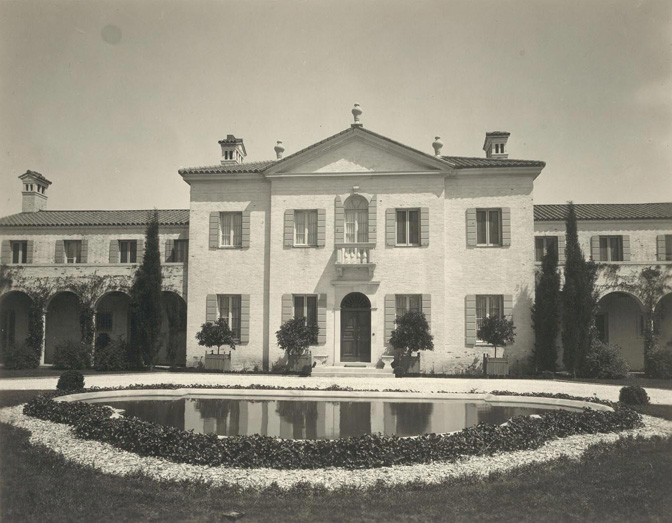
The Clubhouse was gradually joined by 18 unique summer cottages, which were scattered throughout the grounds by the club’s most illustrious guests. First to appear was William Rockefeller’s house called “Indian Mound.” Built in 1892, architect Gordon McKay crafted its memorable façade. Rockefeller’s cottage was then followed by structures like the Dutch-style Moss Cottage (1896) and the Georgian Revival-style Goodyear Cottage (1903). Some of the cottages featured cutting-edge amenities for their day, such as the electric elevator installed inside the Mistletoe (1903). But perhaps the greatest of the summer homes emerged at the club around the start of the Roaring Twenties. Richard T. Crane’s marvelous Crane Cottage is one such building. Built upon the site of an earlier house called “Solterra,” Crane’s residence cost around $500,000 to complete. It displayed some brilliant Spanish Revival-style architecture and was the largest of the club’s summer cottages. It was then followed by two more cottages called “Villa Ospo” and “Villa Marianna.” Built in 1928 for Walter Jennings and Frank Gould, respectively, the two were referred to as villas for their resemblance to Mediterranean palatial estates.
The rest of the Jekyll Island Club Resort complex contains many other unique historic structures. The most noteworthy of these buildings is “San Sourci,” which first appeared on the campus in 1896. A group of members led by John P. Morgan developed this fascinating construct, which many architectural historians have since considered to be among the first condominiums in the United States. Translated as “without care,” San Sourci stood three-stories tall and offered six luxurious suites. The resort is also home to Faith Chapel, a quaint church created with Gothic Revival design aesthetics. Built in 1904, the chapel featured four gargoyles inspired by the ones that adorn Notre Dame in Paris. Inside, is the spectacular King David Window, which many believe was installed personally by Louis c. Tiffany of Tiffany Co. The original proprietors of the club even constructed a luxurious indoor tennis facility that they called the “Morgan Tennis Court.” This local landmark was transformed a century later into a terrific convention center known simply as the “Morgan Center.”
Famous Historic Events
Drafting of the Federal Reserve System (1910): While the actual founding of the Federal Reserve financial system occurred in 1913, several prominent American politicians met at the Jekyll Island Club Resort three years prior to draft its legislation. In the wake of the Panic of 1907, Senator Nelson Aldrich of Rhode Island called for a convention of the nation’s leading financial figures to discuss important economic reforms. Many answered his summons, including representatives from several major banks like the National City Bank of New York and the J.P. Morgan Company. A.P. Andrews—the Assistant Secretary of the Treasury Department under President Theodore Roosevelt—attended the event. The group departed the northeast together in early November onboard a top-secret train bound for the resort. Upon their arrival, they spent the next several days holding discussions that led to the creation of the Federal Reserve Act. This new law would allow for the establishment of a central banking system that could help alleviate future financial crises. It would then play an important role in subsequent economic collapses, including the Great Depression and the more recent Great Recession.
Famous Historic Guests
- Joseph Pulitzer, celebrated publicist of the New York World and namesake of the Pulitzer Prize.
- John P. Morgan, legendary financier and founder of J.P. Morgan and Company.
- William Rockefeller, financier who helped co-found Standard Oil with his brother, John D. Rockefeller.
- George Fisher Baker, founder of Citibank’s predecessor, the First National Bank of New York City.
- Richard T. Crane, founder the modern aerospace manufacturer, Crane Co.
- Marshall Field, founder of Marshall Field and Company department stores, as well as the namesake to the Field Museum of Natural History.
- James Jerome Hill, renowned Chief Executive Officer for the Great Northern Railway.
- Theodore N. Vail, renowned President of American Telephone & Telegraph (now known as AT&T).
- Nelson Aldrich, Republican Senator from Rhode Island (1881 – 1911) and father of the Federal Reserve System.
Film, TV and Media Connections
- Glory (1989)
- Legend of Bagger Vance (2000)
- X-Men: First-Class (2011)
- Live by Night (2016)